Tuesday, March 6, 2012

Marquette Tribune article about AIM students and CFA Challenge

AIM undergraduate investors advance to regional competition

March 6, 2012


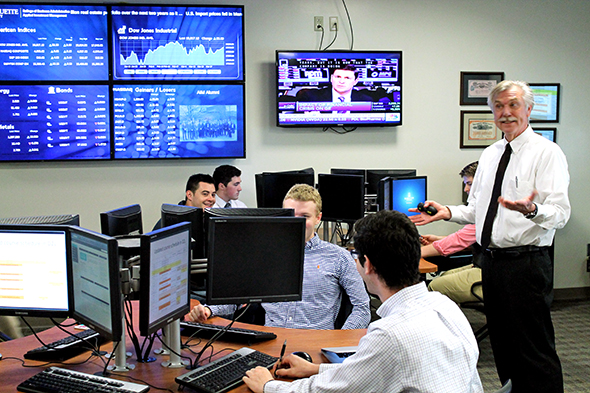
Marquette's Applied Investment Management team is moving on to the regional competition for the fourth year in a row in the Certified Financial Analysts Research Annual Research Challenge. / Photo courtesy of Dr. David Krause

By Eric Oliver, Special to the Tribune

Marquette’s Applied Investment Management Team continues its four year local winning streak this April as they advance to the regional competition in New York to compete in the Chartered Financial Analyst Institute’s Annual Research Challenge.

The team, comprised of College of Business Administration seniors Jacob Bear, Harrison Davis, Colleen Osborne, Bronson Wetsch, and Alice Wycklendt, faced off against Carroll University, the Milwaukee School of Engineering, the University of Wisconsin-La Crosse and the University of Wisconsin-Milwaukee in February.

The main goal of the competition to present the best analysis of a publicly traded company. For the local competition, the team received Marcus Corporation, based in Milwaukee. The team members then wrote a research report and presented their analysis to a panel of judges.

According to David Krause, director of the AIM program and an adjunct professor in the college, he and the team were excited to be advancing past the local round once again.
“We’ve been in the (local) competition four times and it was the fourth time that we won, so it was a good feeling,” Krause said. “I’m not going to say that I expect it every year because the competition is very challenging … Many of the schools have graduate students competing, and we are an undergraduate team.”

During the regional competition in New York, they will compete against 48 other universities from across North and South America, and if they win they will advance to the semifinals to compete against more universities from Europe and Australia.

“We’re not intimidated by the big schools,” Krause said. “You only have 10 minutes to go in and present your case. We only care about the judges. The students don’t care about the other people in the room, whether they are students from MIT or Stanford. The point is the students can compete at that level.”

Each year Marquette returns to regionals, the playing field grows. In 2008, there were just 16 universities competing.

“Regionals bring the champions of local competitions from North and South America,” Krause said. “The level of competition is very high; teams from MIT and Stanford are par for the course.”
The looming challenges of regionals are not lost on the team, however, as each member is modest about the win.

“There are a lot of good global universities and teams that are competing, but I think we all know what we are capable of,” Wetsch said. “Whether we win or not, the learning experience is the most important part.”

While the thrill of the competition is an added bonus for Wetsch, Osborne and Wycklendt, they couldn’t stress just how thankful they were to be parts of this year’s AIM team.
“Marquette and the students in the program are very fortunate to have AIM,” Wycklendt said. “The group of people dedicated to running the program is outstanding, and it really provides exceptional opportunities for students.”

Wetsch recalls that before the AIM program he didn’t know a lot of people in the college, but through the program he expanded his personal and professional networks to heights that never would have been possible without it.

Perhaps his biggest takeaway from being a member of the AIM team was finding the ability to come together as a team.

“It just pushes the point that in this industry, you have to work together as a team,” he said. “There may be differences, but you really have to come together and put the work into it.”

Osborne said being a member of the AIM team has been integral to her Marquette experience.
“It has definitely made my Marquette experience that much better,” she said. “Like Bronson said, it hasn’t only allowed me to figure out what I want to do, but I’ve met a lot of new people with the same interests, so it’s been a really good experience for me.”

Monday, March 5, 2012

Complete February 2011 Performance Reports for the Funds Managed by the AIM Class of 2012

To view the full performance reports, click on the link: Complete February 2011 Performance Reports for the Funds Managed by the AIM Class of 2012


From Bloomberg: Milwaukee’s Home-Grown Managers Shun Fads

http://www.bloomberg.com/news/2012-03-05/milwaukee-s-home-grown-managers-shun-fads-to-post-top-returns.html

Albert Nicholas, the dean of Milwaukee money managers, has a theory why the mid-sized city best known for beer and bratwurst is home to so many top-performing mutual funds.
“We are not as influenced by fads and trends as people on the coasts,” said Nicholas, who has run the $1.7 billion Nicholas Fund since 1969. “We are very independent.”

Morningstar Inc. (MORN) in December named funds run by two Milwaukee firms -- Artisan Partners LP and Fiduciary Management Inc. -- as finalists for its domestic stock manager of the year. The $580 million FMI Focus Fund (FMIOX) beat 99 percent of rivals over the past 15 years, and eight more funds managed near Wisconsin’s largest city, including the $10.1 billion Wells Fargo Advantage Growth Fund (SGROX) and the $2.4 billion Heartland Value Plus Fund, outgained at least 94 percent of peers over the past 10 years.

By comparison, only seven mutual funds based and managed in Chicago, which has four times the population and five times as many funds, beat 94 percent of peers over 10 years, Morningstar data show. Results for funds managed in Chicago for firms based elsewhere can’t be tracked, the company said.
Many of Milwaukee’s money managers, who collectively oversee about $57 billion in assets spread across 61 mutual funds, offer an explanation similar to Nicholas’s for the city’s success: its isolation from centers of finance. Milwaukee is 733 miles (1,180 kilometers) from Wall Street and 89 miles from Chicago, according to Bloomberg maps.
‘Fewer Toys’
“I don’t have any neighbors who run hedge funds,” said Andrew Stephens, whose $5.4 billion Artisan Mid-Cap Fund (ARTMX) beat 99 percent of peers since its start in 1997. “No one is constantly talking stocks to me. I am happy here in my ignorance.”
Patrick English, FMI’s chief executive officer, said down-to-earth Midwesterners are less concerned about “the size of your house or boat” than their counterparts elsewhere. “It is easier to focus on research when there are fewer toys to manage,” he said in an e-mail.
Much of the city’s money-management community can trace its roots to Nicholas. Known as “Ab,” the 81-year-old Nicholas got his start at the University of Wisconsin in Madison, where he studied under Frank Graner, a dapper, chain-smoking professor of finance. At a time when investing was usually taught as a dry academic subject, Graner was an inspiring lecturer who emphasized stock-picking, Nicholas said.
‘The Pied Piper’
Ted Kellner, who started FMI, and William Nasgovitz, founder of Heartland Advisors Inc., both in Milwaukee, also studied under Graner. “He was the pied piper of investment studies,” Nicholas said in a telephone interview.

In 1967 Nicholas started an investment firm with Richard Strong, another Wisconsin graduate. Seven years later, Strong created his own company, Strong Capital Management Inc., whose mutual funds were acquired in 2004 by Wells Fargo & Co. Kellner, who replaced Strong at Nicholas Co., founded FMI in 1980. In 1994, Carlene and Andrew Ziegler left Strong to set up Artisan Partners.

The University of Wisconsin link remains strong today. About 60 people who work for Milwaukee firms are graduates of the school’s Applied Security Analysis Program, which trains money managers, according to Brian Hellmer, its director.
Real-World Experience
Students in the master’s degree program get real-world experience by managing $53 million that comes from the university’s endowment and alumni donations, Hellmer said. Thomas Ognar, manager of the Wells Fargo Advantage Growth Fund, and Adam Peck, co-manager of the $2.4 billion Heartland Value Plus Fund (HRVIX), are both graduates of the program. Ognar’s fund beat 99 percent of rivals over the past 10 years and Peck’s beat 97 percent, Morningstar data show.

With a population of 595,000, Milwaukee is America’s 28th largest city, according to the 2010 U.S. census. In the mid-1960s, four Milwaukee brewers -- Blatz, Pabst, Schlitz and Miller -- were among the top 10 beer makers in the world, according to the Museum of Beer & Brewing. Miller, which is owned by London-based SABMiller Plc (SAB), is the only one still operating a brewery in Milwaukee today.
Harley-Davidson Inc., the biggest U.S. motorcycle maker, and Johnson Controls Inc., the largest U.S. auto supplier, are both based in Milwaukee.
‘Live Like Kings’
Most of the mutual fund companies are clustered along the shore of Lake Michigan in the city’s downtown, which features wide streets and little traffic. Money managers boast of their short commutes and affordable homes.
“Professionals can live like kings here compared to Boston and New York,” FMI’s English wrote in an e-mail. A median-priced single-family house in the Milwaukee metropolitan area cost $181,000 in the fourth quarter of 2011, according to the National Association of Realtors, compared with $325,000 in Boston and $363,000 in New York.
The climate may not be as big a draw. The average January temperature is 21 degrees Fahrenheit (-6 degrees Celsius) compared with 32 in New York.
The Milwaukee firms that run equity funds emphasize individual stock selection and their own research over seeking to ride macroeconomic trends.
“It is too risky to make big macro bets,” Wells Fargo’s Ognar said in an October interview.
Read 10-Ks
In that same interview, he described Apple Inc., his largest holding, as a cheap stock, even though it had recently hit a record price of more than $422 a share. Apple closed March 2 at $545.18 in New York trading.
FMI, which manages $12.5 billion, Heartland and Artisan all stress their bottom-up approach. In an interview in his firm’s Milwaukee office, Eric Colson, Artisan’s CEO, described his money managers as people “who like to sit in the corner and read 10-Ks.”
Artisan, with $65 billion in assets, including funds managed by teams in other cities and money in separate accounts, withdrew a planned initial public offering in December, citing market conditions. One of the company’s value investing teams, based in Atlanta, won Morningstar’s award for domestic stock manager of the year in 2011.
Heartland’s Nasgovitz called himself a disciple of Benjamin Graham, the legendary investor who was Warren Buffett’s professor at New York’s Columbia University. Like Graham, Nasgovitz looks for companies with little debt selling at a discount to their long-term value.
Bucking Trends
Heartland Value Plus attracted $770 million in 2011, according to Morningstar, bucking a trend that saw investors pull $135 billion last year from funds that buy U.S. stocks, according to data from the Investment Company Institute, a Washington-based trade association.
The $5.1 billion FMI Large Cap Fund (FMIHX), whose managers were also nominated for Morningstar’s top award for 2011, gained $791 million. Ognar’s Wells Fargo fund won deposits of $4.5 billion, which ranked it among the 20 most popular U.S. mutual funds, Morningstar data show.
On the bond side, Lyle Fitterer’s $2.7 billion Wells Fargo Advantage Municipal Bond Fund (SXFIX) beat 99 percent of rivals over the past 10 years, Morningstar data show. After the municipal market sold off in December 2010 following analyst Meredith Whitney’s prediction that there would be “hundreds of billions” of dollars of defaults, Fitterer said her forecast was off the mark.
‘Latest Sizzle’
“I am not saying there won’t be defaults,” Fitterer said in a January 2011 interview. “But I have a hard time getting to $10 billion, let alone $50 or $100 billion.”
Fitterer’s fund gained 10 percent last year as defaults totaled $2.6 billion, excluding tax-exempt debt in AMR Corp.’s bankruptcy, according to Matt Fabian, a managing director at Concord, Massachusetts-based Municipal Market Advisors.
The $754.7 million BMO Intermediate Tax-Free Fund (MITFX) beat 99 percent of competitors in the past five years, Morningstar data show. In December 2010, Bank of Montreal (BMO) agreed to buy Milwaukee-based Marshall & Ilsley Corp., the fund’s owner, for about $4.1 billion in stock.
The $1.4 billion Baird Core Plus Bond Fund (BCOIX), managed by Mary Ellen Stanek, beat 94 percent of rivals over 10 years. In 2008, her $1.2 billion Baird Intermediate Municipal Bond Fund (BMBIX) beat 99 percent of similar funds by sticking to higher-quality issues, she said.
“We are hard-working Midwesterners here,” Stanek, president of Baird Funds Inc., said in an interview. “We may not always have the latest sizzle, but that sizzle often doesn’t add value.”

To contact the reporter on this story: Charles Stein in Boston at cstein4@bloomberg.net   To contact the editor responsible for this story: Christian Baumgaertel at cbaumgaertel@bloomberg.net

Sunday, March 4, 2012

The Marquette AIM Fixed Income Fund posted a return of 0.31% in February 2012. Key performance and portfolio metrics are displayed below. (Click on the images below to see a larger view).


AIM International Equity Fund as of February 29, 2012

The Marquette AIM International Equity Fund posted a return of 4.65% in February 2012. Key performance and portfolio metrics are displayed below. (Click on the images below to see a larger view).


AIM Small Cap Equity Fund as of February 29, 2012

The Marquette AIM Small Cap Equity Fund posted a return of 2.65% in February 2012 - and is 468 above the Russell 2000 the past 12 months. The following tables and charts provide performance data and key metrics for the AIM Fund. (Click on the images below to see a larger view).


Save the Date: April 24th for Marquette COBA Economic Forum

A presentation and panel discussion titled, The European Financial Crisis – How Will it Affect You and Your Company, will take place on Tuesday April 24, 2012 from 5:30 pm to 7:00 pm in Straz Hall 105 with a reception in the lobby of Straz Hall following the event.  

The objective of the forum is to raise awareness of the College of Business Administration’s global reach and to expose students to global issues. The event will feature Freddy van Den Spiegel (Chief Economist, BNP Paribas Fortis and Chair, Global Banking Issues Committee, European Banking Federation).   

The panel includes: 
  • Freddy van Den Spiegel, Chief Economist, PNB Paribus, Fortis (Keynote presenter and moderator)
  • Mike Van Handel, Executive Vice President and Chief Financial Officer, ManpowerGroup
  • Andy Busch, Chief Strategist for Foreign Exchange Operations and BMO Harris
  • Ulice Payne, President, Addison-Clifton, LLC
  • and others. 

The guest list will include the Dean's Council of Excellence members, students, EMBA alumni, MU Milwaukee alumni, and constituents of MMAC, MWTA, and Wisconsin World Trade Center. Make note to Save the Date....


Saturday, March 3, 2012

Another Successful Visit to Chicago by the Students in the AIM Program on Friday, March 2nd


On Friday, March 2nd, Dr. David Krause (Marquette University's AIM program director) and the students in the AIM Class of 2013 visited Chicago. Despite the forecast for an early March snowstorm, the students departed Milwaukee before dawn. Dr. Krause and the AIM students were accompanied by Brady Endl (AIM program Graduate Assistant), Mike McGuire (MSAE student), Sarah Smith (Marquette Advancement), and George Koonce (Marquette Advancement).


The first stop was at Ziegler Lotsoff Capital Management. The investment professionals at Ziegler Lotsoff and the AIM students met in the board room and Dr. Krause provided an overview of the AIM program. Four students (Elizabeth Buckton, Brent Adams, Yatina Liu, and Varun Varma) then made their first equity pitches. Ten investment professionals at Ziegler Lotsoff Capital Management (20 N. Clark Street) attended the student presentations and asked questions. They also offered valuable comments and suggestions following the students’ stock pitches.
AIM Student Presentations at Ziegler Lotsoff

Don Nesbitt
Don Nesbitt, CFA, (Managing Director and Co-Chief Investment Officer – Equities) and Mark Burka, CFA, (Senior Vice President, Portfolio Manager) provided particularly valuable commentary to the students about the equity research process. Dr. Krause said, “We will be certain to host these two experienced and seasoned investment professionals in the AIM room soon – their comments resonated with the students. The value of visiting investment professionals at their firms was again evident.”

Maggie Baer
Dr. Krause said, “This was the AIM program's second visit was to Ziegler Lotsoff and it was again a success. The students and investment professionals had a productive discussion about the best practices of successful investment research and professional presentations. We are thankful to our hosts: Scott Roberts (President  & CEO), and  Maggie Baer (Managing Director and Chief Administrative & Operating Officer). We look forward to future visits.”

Albert Grace, Jr.
The student then traveled to Loop Capital at 200 W. Jackson Blvd.  They had an opportunity to meet and visit with Albert Grace, Jr. (Co-Founder and President) and several of his associates (Paul Bonaguro, Eric Lane, and Booker Whitt). In addition, Paul King of Northern Trust also attended the meeting. The meeting was held in Loop Capital's executive board room.


The four AIM students again had the opportunity to present their first AIM equity recommendations (see table below).


Dr. Krause commented, "The students did an outstanding job pitching their stocks. What was most impressive is that these are the juniors in the AIM program - they have literally been in the AIM Room less than two months and they are already doing professional level analysis and presentations in executive board rooms. I was very pleased with the questions and comments from the professionals that joined Mr. Grace to hear the student presentations."

The students were then treated to a tour of Loop’s trading floor. Dr. Krause commented, “We are very appreciative of the opportunity to meet with Mr. Grace and his associates. Loop Capital is an impressive firm and the AIM students enjoyed the opportunity to meet with some of the traders and investment professionals. It was a wonderful visit.”


Dave Kucera
The third and final investment firm that the AIM students visited was BMO Capital Markets at 115 S. LaSalle. Marquette alumni David Kucera (Managing Director and Head of U.S. Securitization) and Steve McManaman (Managing Director, Financial Products) arranged the visit and gave the students an excellent update on the capital markets and the securitization process. The visit concluded with a tour of the BMO’s massive trading floor.


Dr. Krause and students then headed north in an attempt to reach Marquette's campus before the snow storm hit - as the picture below shows - they encountered snow at the Wisconsin border. Nevertheless, the group returned to campus safely. The students were impressed with all of the people they met during their first Chicago AIM field trip and were thankful for the opportunity to visit Ziegler Lotsoff, Loop Capital, and BMO Capital Markets.