Thursday, May 4, 2017

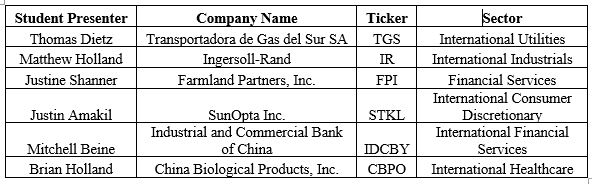
The Fifth Set of Stock Pitches for the AIM Class of 2018 are on Friday, May 5, 2017 at 2:30 CST – Join us.


You can join the AIM Program Student Equity Presentations in person, online or via Twitter on Friday, May 5th at 2:30 pm CST

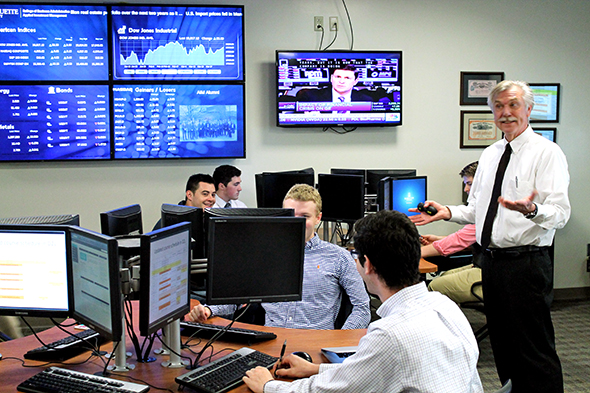
The AIM student equity pitches take place each Friday afternoon during the semester – either in the AIM Room or at a local investment company. Watch the live presentations by the students in the AIM Class of 2018 (see webcast link below).


The students prepare and distribute a professional equity write-up (note: every AIM write-up since the inception of the program in 2005 is archived here).


 This week’s equity write-ups can be found at:


The students are responsible for making a seven-minute pitch before their peers, faculty and any alumni or investment professional in attendance. Following the student’s pitch the floor is opened for questions and answers for about ten minutes. This has been highly instructive, as the students must be prepared to defend their investment recommendation and answer questions in an extemporaneous manner.


How to comment using Twitter:

  • Go to the MarquetteAIM Twitter account (you can use Search Twitter on your site) and click Follow
  • During AIM presentations, go to #AIMpitch and follow the tweets (discussion) on Twitter (it will also be appearing on the Rise Display Board in the AIM Room and on your smartphone)
  • Tweet your comments and questions during the AIM equity pitches
    • Follow the rules of etiquette for using Twitter during AIM pitches
    • Use the hashtag #AIMpitch to start each tweet
    • Use $TICKER (note: this is called a cashtag and it be should the unique ticker/symbol for the stock that is being presented, ex: $TSLA)
    • Keep you comment short because each tweet is limited to a maximum of 140 characters
    • Example for Tweeting on a student’s Tesla equity pitch (note: the ticker for Tesla is TSLA):
      •  #AIMpitch $TSLA How do lower gas prices impact demand for electric cars?

A current AIM Fund holding: Schneider Electric ADR (SBGSY) by Kevin Blank. “Ready for 21st Century Challenges"

 Schneider Electric Unsponsored ADR (SBGSY, $15.79): “Energy in the Cloud”
By: Kevin Blank, AIM Student at Marquette University


Disclosure: The AIM Equity Fund currently holds this position. This article was written by myself, and it expresses my own opinions. I am not receiving compensation for it and I have no business relationship with any company whose stock is mentioned in this article.

 Summary
Schneider Electric (OTC:SBGSY) is a global specialist in energy management, electrical distribution, and industrial engineering equipment. The company offers integrated products and solutions across four markets (non-residential and residential buildings, utilities and infrastructure, industry and machine manufacturers, and data centers and networks).

• Schneider Electric is answering customer’s needs on how best to take advantage of today’s speedy digital world.

• The recent announcement of collaborating with Microsoft by using Azure in Schneider’s EcoStruxure architecture will accelerate the delivery of cloud-based applications. 

• Increased construction in Europe and North America can drive utility spending.

• The company is focused on disciplined value-accretive M&A to grow core business areas.

Key points: Schneider Electric’s market leader position in the key applications in distributed information technology, data centers, and non-IT applications creates long term drivers for growth. The company operates across 200 countries and growth areas include increased installed base for battery energy storage systems, internet traffic, edge computing IoT devices, and cloud data centers.

Cloud-based applications deployed by IT and automation companies drive plants, buildings, people and asset optimization. Partnering with Microsoft in addition to Accenture, Intel, Cisco, IBM, and Salesforce allows for significant upside in the IoT space. 45% of revenues relate to IoT. Schneider’s EcoStruxure digital platform delivers business value through apps, edge control, and connected products on-site and in the cloud. Demand for IT and business automation solutions continues to grow and Schneider’s total addressable market expanded from 60B euro to 300B euro.

The building business segment grew 3.8% in Q1 with China responsible for double-digit growth. Non-residential construction markets are a large influence for Schneider Electric. Europe and North America construction markets could have a strong 2017, increasing low voltage products and systems (switchboards, circuit breakers, cabling and interfaces) and medium voltage distribution (transformers). New trends in power generation are moving towards a technological evolution through microgrids, energy storage, and renewable energy.

Although M&A is not necessary, management has stated potential M&A to strengthen leading positions in the core business areas (power, building, and software). The company has also generated 1.4B euro in cash from disposals of non-core businesses.

What has the stock done lately?
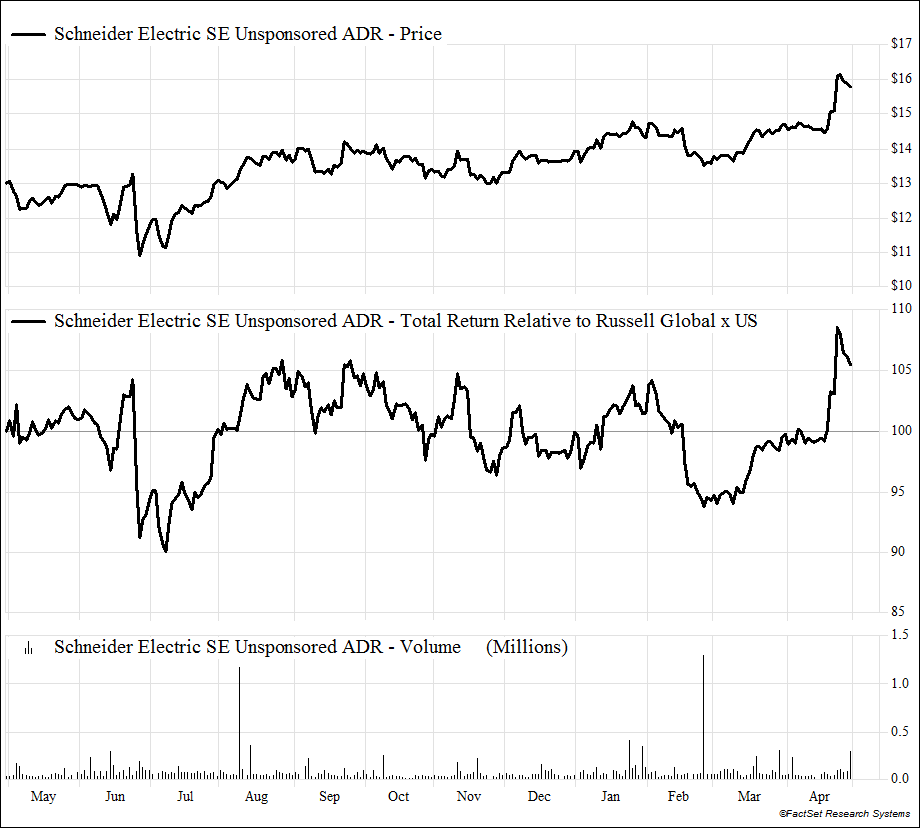
SBGSY has hovered around $13 – $14 with a recent spike after Schneider Electric posted a positive 1Q17 sales report on April 20th, showing organic growth across all business segments. This news resulted in a 3.55% increase. April has been a strong month for Schneider with a $900M sale of DTN, a data software business that distributes real-time weather information to farmers and other customers. Schneider said proceeds from the deal will be used in a share buyback of about 1B euro and recover from other acquisitions. The month of April posted an 8.77% increase in share price.

Past Year Performance: The stock has increased 20.53% over the past year. The 52-week range is $10.92 - $16.15. Schneider posted $1.93B net income in 2016 which increased from $1.55B in 2015 although revenues decreased largely due to foreign currencies depreciating against the euro.


Source: FactSet

My Takeaway
The age of digitization in the energy markets is catching up globally and Schneider Electric’s end markets are becoming more electric, digitized, and automated. Schneider’s ability to partner with leading IT and automation companies increases their knowledge base in determining customer’s needs. System and solution engineers can integrate and design product capabilities with strong alliances. I expect Schneider Electric to continue to be a leader worldwide and strengthen core businesses through M&A.


Source: FactSet


Wednesday, May 3, 2017

A current AIM Fund holding: PCTEL (PCTI) by Joseph Amoroso. “Weak Connection. PCTEL in Critical Condition”

PCTEL, Inc. (PCTI, $7.75): “PCTEL Investment Thesis in Critical Condition”
By: Joseph Amoroso, AIM Student at Marquette University


Disclosure: The AIM Equity Fund currently holds this position. This article was written by myself, and it expresses my own opinions. I am not receiving compensation for it and I have no business relationship with any company whose stock is mentioned in this article.

 Summary
PCTEL, Inc. (NYSE:AIG) provides performance critical telecom solution for wireless networks. The company operates across North America, Asia and Europe with two product segments: Connected Solutions and RF Solutions.

• The proliferation of Small Cells, 5G, and the Internet of Things (IoT) represent exciting growth opportunities for PCTI.

• Contrary to expectations, revenue mix has not changed since first being added to the AIM portfolio.

• Company has experienced significant customer consolidation.

Key points: Performance Critical TELecom is ripe for removal from the AIM Domestic Small Cap portfolio. PCTI has ultimately fallen away from the drivers of its original recommendation and with an extremely impressive month of price performance behind it, is in a positon to be trimmed before the AIM class of 2018 leaves for the summer.

As we look ahead to the expansion of 5G, management is very optimistic about the positioning of the company in being able to capitalize on the next big jump in wireless networking. Due to the higher frequencies of a 5G network, these frequencies travel much short distances which inherently creates the need for more small cells. Small cells mark a change away from traditional macro cell towers which broadcast network access across a wide distance. 

Conversely, small cell allows for many small and densely placed cells to together provide widespread access. This operates the same way MU Wireless operates with all of those small white boxes placed in the ceiling tiles all across campus. Management expects small cell shipments to more than double by 2020 which would result in more than 10M units being shipped. It is anticipated that by the very nature of 5G, high frequency and short distance, 10x the number of base stations will need to be employed in order to handle the network as opposed to the existing 4G infrastructure.

Originally, the company was pitched under the prediction that the company’s higher margin business, RF solutions, would rapidly begin to grow as a share of total revenue moving towards 2020. Ultimately making up nearly 50% of total revenue. This represented a significant driver of revenue growth and margin accretion. However, the revenue mix has stayed about the same with RF solutions representing 32% and Connected Solutions representing 68% of total revenue in fiscal year 2016. Instead, significant growth is coming from within the company’s Connected Solutions business where antennas used in wireless devices and cellular networks represents the company’s top growth market. 

Management has made an effort to divest itself of lower margin businesses over the past few years, but the key migration to RF representing a greater percentage of total revenue has yet to materialize.
Finally, another significant driver for the company was that they had a diversified customer base. However, the company recently announced that Huawi, a key Asian customer, now accounts for more than 11% of total fiscal year 2016 revenue. Additionally, with the anticipated growth in small cell shipments companies such as China Mobile, Vodafone, and Verizon will continue to grow as a part of revenue.

What has the stock done lately?
In the last month, PCTI is up more than 30%. This was largely driven by a Sell-Side initiation from Lake Street Capital Markets at a price target of $8.00 and as a result of Wunderlich Securities raising their price target from $7.00 to $8.50 in addition to other macro variables. This recent support for the stock appears to be a unique exit point as some of the drivers behind the company’s original admission to the AIM portfolio continue to deteriorate. Furthermore, the company plans to release Q1 earnings on May 9th with consensus EPS of $0.03 which has the potential to result in increased price volatility.

Past Year Performance: PCTI has increased 72.32% in value over the past 12 months. After originally being pitched at a price of $5.96, PCTI proceeded to fall below $4.50 before experiencing significant upward momentum in 2017.


My Takeaway
Despite significant growth within the exciting 5G and IoT markets, the drivers for this company have not materialized as expected. A critical driver of margin accretion driven by RF solutions increasing their total share of revenue from ~30% to ~50% has not occured and connected solutions continue to remain the largest and fastest growing revenue source for the company, with RF remaining stable. Ultimately, I believe we have a unique opportunity to exit this position before leaving for the summer while still recognizing an upside of 29.53%.


A current AIM holding: Calavo Growers. (CVGW) by Charles Muth. “Pass the Chips - Calavo Looking Tasty"

Calavo Growers Inc. (CVGW, $66.00): “Looking Ahead: Demand Driven Growth?”
By: Charles Muth, AIM Student at Marquette University


Disclosure: The AIM Equity Fund currently holds this position. This article was written by myself, and it expresses my own opinions. I am not receiving compensation for it and I have no business relationship with any company whose stock is mentioned in this article.

 Summary
·      Calavo Growers Inc. (NASDAQ: CVGW) markets and distributes avocados and other perishable foods through their Fresh Products (49.5% FY16 Revenue), Calavo Foods (7.4%), and Renaissance Food Group (43.1%) segments. CVGW predominantly operates within the U.S. and customers include food distributors, produce wholesalers, supermarkets, convenience stores, and restaurants.

·      The Fresh Products segment prepares avocados for customer delivery, the Calavo Foods segment purchases, manufactures, and distributes a diverse selection of prepared products (guacamole), and the Renaissance Food Group (“RFG”) sources, markets, and distributes health focused, fresh packaged food products.

·      Increased domestic demand for avocados (guacamole products) at double-digit rates and CVGW’s competitive market position as a leading avocado producer contribute to expected future growth.

·      A growing, diversified, and year-round supply of avocados support market expansion and stability.

·      CVGW’s continued company reinvestment and attitude towards accretive acquisitions highlight management’s growth strategy and indicate strong future performance.

·      The RFG segment is working to build a top-notch operation on quick-turn order fulfillment and just-in-time retailer distribution. This segment had double-digit revenue growth and offset declines in the Fresh business during 1Q17.

Key points:
CVGW has taken advantage of the 4x increase in domestic avocado consumption since 2000. Throughout 2016, over 2.3 billion total pounds (5.2 billion avocados) of this “superfood” were consumed. In addition, 29% of millennials aged 21-34 are willing to pay a premium for more healthy food options and 47% of individuals aged 18-34 have adopted a healthier diet from the prior year. Accordingly, the year-round supply and increased popularity of avocados has spurred innovative recipes and put avocados in the spotlight as a delicious, healthy food trend.
The volume of avocados delivered to company packing facilities directly impacts operating performance. In addition to using Mexican sourcing facilities, CVGW’s strategy focuses on retaining and recruiting growers who comply with their business model. With an increase in expected future demand, CVGW plans to expand and diversify sourcing operations. While solidifying avocado supply by diversifying these sourcing operations, CVGW also limits inclement weather and sourcing facility risk.

Over the last few years, CVGW has placed an emphasis on company reinvestment and expansion. Recently, the Jalisco facility in Mexico was completed. This facility plans to be authorized for U.S. export in the near future and may be a strong sourcing connection. In addition, CVGW has expanded RFG production capacity by 260,000 square feet in Florida and Texas. CVGW maintains interest in future acquisitions, but puts an emphasis on larger companies (>$100M) that are instantly accretive.

Moving forward, major operating concerns include inherent farming risks, international exposure, and the presence of generic brands. First, in addition to being reliant on the market forces (supply and demand) for products, inclement weather and other environment concerns can negatively impact operational performance. Second, the firm sources raw materials from Mexico and are subject to several factors including organized crime, regulations, and taxes. Lastly, large retail stores negatively impact firm performance with significantly lower priced products.

What has the stock done lately?
Since CVGW released 1Q17 results on March 7, 2017, the stock has increased nearly 30% (from $51.20). Despite missing EPS by $0.10, the stock increase is driven by management’s double-digit revenue, margin, and EPS guidance. Looking forward, avocado demand is expected to be strong and the RFG segment will continue to drive earnings. Following this earnings release, company insiders’ increased stock holdings in CVGW throughout March and April, further driving investor confidence.

Past Year Performance:
Throughout the last six-years, Calavo Growers has posted consecutive, all-time high gains in revenues, margins, and earnings per share. CVGW’s stock increased 17.6% (from $56.11 on 04/25/16) in value over the past year. Also, FY16 revenue increased 9% YOY, gross margin increased 26%, and operating income increased 40%. 

Specifically, this gross margin growth highlights increased operational efficiencies coupled with industry expertise in sourcing, production, and management. CVGW is aware of the surrounding operating environment and stays consistent with their strategic objectives, while remaining nimble to adjust with changing market conditions.

1 Year Stock Chart vs. Benchmark from FactSet here

Source: FactSet

My Takeaway
Calavo Growers operates under a competent management structure that has taken advantage of the growing avocado market. In addition to posting all-time high earnings in 2016 and increasing the dividend payout 12.5% to $0.90, CVGW has identified strong future demand in the avocado market. Accordingly, the firm has worked to diversify and expand sourcing operations through company reinvestment and expansion. By taking preemptive action towards locating diversified sourcing locations, CVGW will be ready to meet customer demand and secure increased market share. Also, despite missing 1Q17 earnings, CVGW has maintained investor confidence by effectively disseminating information regarding the missed quarter guidance and updated year outlook. Based off this analysis, I recommend that CVGW be kept in the AIM Small Cap Fund at its current weight and be watched throughout 2017 until additional concrete information is given regarding future market demand of avocado products.

1 Month Stock Chart from FactSet here


Source: FactSet


Tuesday, May 2, 2017

This Week's Visitors to the AIM Program: Chris Caparelli and Nat Kellogg of Marquette Associates


Nat Kellogg and Chris Caparelli in the AIM Room

Marquette Associates
Marquette University students in the Applied Investment Management (AIM) program and Alternative Investments classes were again treated to a presentation by Chris Caparelli and Nat Kellogg of Marquette Associates. The advising firm, based in Chicago, has provided independent investment consultation since its founding in 1986. 

Marquette Associates places client fiduciary duties first through complete independence and 100% employee ownership. The firm serves over 300 clients with over $133 billion in assets – from public funds, unions and corporations to endowments, foundations and other non-profits.

Dr. David Krause, AIM program director said, “Chris and Nat do an excellent job in the classroom and their informal discussions with the AIM students was outstanding. We discussed behavioral finance, investment trends, passive vs. active management, and data analytics. Besides the traditional hedge fund lecture they deliver each spring in my Alternative Investments class, they also are first-rate at engaging the students in conversations. I think the discussion about the challenges of investing in fast-moving, technology-driven markets was especially good. I always look forward to their visit each year.”
 Chris Caparelli, Nat Kellogg and David Krause


Dr. Krause added, “I have worked with several consulting firms over the years and I do appreciate the work produced by Marquette Associates. They provide timely and measured advice – I’m pleased we have been able to establish a long-term relationship with them.”

Chris Caparelli
Chris Caparelli, CFA, is an Assistant Vice President and serves as an investment consultant on several of the firm’s relationships. He was an Evans Scholar at Marquette University, where he graduated in 2008 with a B.S. in finance from the Applied Investment Management program. He also holds an M.B.A. in finance from Northwestern University’s Kellogg School of Management.  Chris's clients include public funds, Taft-Hartley plans, and nonprofits. He serves on the firm’s traditional investment manager search committee. Prior to joining Marquette, Chris was an analyst in the fund marketing group of Henderson Global Investors.

Nat Kellogg
Nat Kellogg, CFA, is the Director of Alternatives and is a Managing Partner. Nat is responsible for reviewing alternative investment research and due diligence particularly in the hedge fund and private equity asset classes. He is a member of the firm’s investment committee and alternative investment manager search committee. Before joining Marquette, Nat was a senior equity analyst at Hudson Securities covering the electrical equipment and basic materials sectors. Previously, Nat was an equity analyst at Brait Specialized Funds, a small-cap focused long/short equity hedge fund. Nat holds a B.A. in history from Middlebury College and an M.B.A. from Northwestern University's Kellogg School of Management. 


A current AIM Fund holding: Agree Realty (ADC) by Robert Noble. “AIM Agrees to Hold ADC. Really"

Agree Realty Corporation (ADC, $50.02): “Agree to Buy”
By: Robert Noble, AIM Student at Marquette University


Disclosure: The AIM Equity Fund currently holds this position. This article was written by myself, and it expresses my own opinions. I am not receiving compensation for it and I have no business relationship with any company whose stock is mentioned in this article.

 Summary
Agree Realty Corporation (NYSE:ADC) is a real estate investment trust that specializes in the acquisition and development of net lease retail properties. ADC operates in 43 states and maintains approximately 7.2 million square feet of leasable space. The company is headquartered in Bloomfield Hills, MI and was founded by CEO Richard Agree in 1971.

•ADC increased funds from operations per share to $0.65 in Q1 2017. This represents a 6.3% increase over the same period in 2016.

•ADC is positioned to surpass its 52 week high of $51.33 after it posting strong first quarter earnings.

•Many of ADC’s large tenants are not at risk to be driven out of business by internet retailers like Amazon.

Key points: Funds from operation is one of the most important statistics to track for real estate investment trusts (REITs). By subtracting depreciation, amortization, and gains from sale of property from earnings, it shows the cash flow of the REIT. ADC’s funds from operations increased 34.5% in Q1 2017 compared to the same period in 2016. This resulted in FFO of $17 million.

In Q1 2017, ADC posted increases in rental revenue, net income per share, FFO, adjusted FFO, and dividends. Rental revenue increased 29.7% to $24.2 million for the quarter, which saw many retailers struggle. Despite the current retail climate, ADC increased both its net income per share and funds from operations. According to FactSet, average analyst projections expect the stock price to reach $52.00.

ADC is uniquely positioned to thrive in the retail leasing environment because of its diverse group of tenants. Clients such as LA Fitness and 24 Hour Fitness will not be driven out of business by internet companies. Fast food chains (Burger King, Taco Belle) and pharmacies (Walgreens, Rite Aid, CVS) represent a significant portion of ADC’s tenants. They require retail space to operate, and are not easily substituted by ecommerce. Other major clients operating in retail driven industries include Mister Car Wash, Lowe’s, and AMC movie theatres. 

What has the stock done lately?
Agree Realty Corporation opened the month at $47.93 on April 3, 2017. On April 23, 2017 ADC closed at its 52-week high of $51.33 in anticipation of strong Q1 earnings. Following the earnings release on April 24, the stock price closed at $50.02. ADC’s Stock has performed well over the month of April, growing 4.36%

Past Year Performance:
Agree Realty Corporation’s stock price has increased 27.02% on the year. The 52-week high is $51.33 and the low is $38.59. It climbed steadily for the year before falling in November 2016 among increased borrowing. Since then, the price has continued its upward climb, recently reaching its 52-week high.


 Source: FactSet

My Takeaway
Agree Realty Corporation has shown steady growth over the last twelve months, increasing by over 27%. Solid 2017 performance has resulted in the stock trading near its 52-week high. I expect ADC to build upon their superb first quarter in 2017 and surpass their 52-week high. They have maintained consistent growth despite the many issues facing retailers. As the retail market continues to decline, I think ADC will be able to perform consistently, as they have over the last twelve months.

Source: FactSet


Monday, May 1, 2017

A current AIM Fund holding: Columbia Sportswear (COLM) by Paige Chiang. "Columbia is an ideal fit for the AIM portfolio"


Colombia Sportswear Co. (COLM, $58.44): “Columbia Keeps Constant”
By: Paige Chiang, AIM Student at Marquette University


Disclosure: The AIM Equity Fund currently holds this position. This article was written by myself, and it expresses my own opinions. I am not receiving compensation for it and I have no business relationship with any company whose stock is mentioned in this article.

 Summary
Colombia Sportswear Co. (NYSE:COLM) designs, develops, markets, and distributes various apparel, footwear, accessories, and equipment tailored towards active outdoor lifestyles. Products are sold throughout the United States, Latin America, Asia Pacific, Middle East and Africa, and they fall under COLM’s four primary brands: Colombia Mountain Hardwear, Sorel, and Montrail.
• COLM is currently combatting the decline in purchases by wholesalers by increasing their online presence through their own website and by partnering with online retailers such as Amazon.com.
• While online sales are increasing, general sales of Mountain Hardwear have been lagging over the last 2 years.  
• On March 6, 2017, management announced that Mr. Joe Vernachio will be the new President of Mountain Hardware effective April 3, 2017.

Key points: Although Colombia Sportswear Co. is a major player in the performance sportswear arena, they still face difficulty when it comes to orders from wholesalers. Many wholesalers that regularly purchase COLM’s gear are struggling in the quickly changing retail environment causing a lag or decrease in orders. COLM recognizes this shift in customer habits from purchasing the majority of items in brick-and-mortar stores to online shopping. 

In the 4Q16 earnings call, management stated that ecommerce sales grew by more than 20% relative to 2015, which accounted for more than 9% of global 2016 sales. In the United States, COLM has partnered with Amazon.com and has their own mini-online store through the Amazon.com platform. This good relationship with Amazon.com dramatically increases their online presence, all while decreasing the brand’s chance of being consumed by Amazon.com – or in other words being “Amazoned.”

Regarding their European online operations, COLM is focusing on building a DTC relationship with their consumers. COLM currently uses a third party that manages the order and shipment of products from their faculties to their final customers. Columbia is now trying to bring that operation in-house using existing infrastructure for warehouses and the established call-center. In addition to the cost benefits associated with this plan, management is excited to “take back the customer” and further provide them with a more brand enhancing experience. COLM expects this insourcing of its European ecommerce operations to be completed by mid-2017.

Over the past couple of years, COLM has seen sales struggle in its Mountain Hardwear division. Mountain Hardwear designs, produces, and sells outdoor athletic apparel and equipment, and is focused on delivering products on the forefront of materials technology and design to customers. Unlike COLM’s other brands, Mountain Hardwear tends to be less traditional and geared more towards athletes that aspire to live boldly. To combat their falling sales, Mr. Vernachio was brought on as President of Mountain Hardware. Mr. Vernachio is viewed as an outdoor athletic goods veteran having served as the Global VP of Product and Operations for The North Face and CEO and Senior VP of Product and Sourcing with Spyder Active Sports. Both of these brands are more similar to Mountain Hardwear’s concept than other COLM brand concepts. Management is hopeful that Mr. Vernachio will help in the repositioning of the Mountain Hardware brand.

What has the stock done lately?
After 4Q16 earnings beat many estimates on February 9, 2017, COLM shares jumped from a close on 2/9 of $53.27 to a close on 2/10 of $60.25. This 13% increase was the largest single day increase that the stock has seen in 2017. COLM has not traded below $55 since 2/9/17, and it has been constantly trading around the $58 mark for the past couple of months. The rapid growth in ecommerce sales combined with the company’s push for online expansion might provide the push that COLM shares need.

Past Year Performance: COLM share prices in 2016 remained fairly constant at ~$55-$60. 2016 was a strong year for Columbia as its gross profit margins saw a 60bp increase to 46.7%, which helped drive their record sales, operating income, and net income figures. Management has indicated that they see sales continue to grow, and the majority of that increase will be from their ecommerce sales rather than traditional sales. COLM currently has a P/E of 21.49x, which is lower than its peer group comps of 22.22x indicating that there is still room for COLM to grow.


Source: FactSet

My Takeaway

Columbia’s push to increase their online presence and connect directly with consumers is very encouraging during this dark time for many retailers. Rather than being sucked into the current that is online retailing, COLM has decided to ride the wave by broadening their ecommerce operations. Also, the new hiring of Mr. Vernachio makes investors hopefully that Columbia will be able to turn around their struggling Mountain Hardwear division. 

All in all, COLM has created a solid brand with loyal followers. As COLM continues to increase its ecommerce presence while decreasing its wholesaling orders, the company places itself in a very comfortable position amongst outdoor athletic retailers.