Tuesday, April 9, 2019

A Current AIM International Equity Holding: FirstService Corp. (FSV, $87.70): “All Grown Up Now” By: Brandon Shanklin, AIM Student at Marquette University


FirstService Corp. (FSV, $87.70): “All Grown Up Now”
By: Brandon Shanklin, AIM Student at Marquette University


Disclosure: The AIM Equity Fund currently holds this position. This article was written by myself, and it expresses my own opinions. I am not receiving compensation for it and I have no business relationship with any company whose stock is mentioned in this article.

 Summary

FirstService Corp. (NYSE:FSV) engages in two segments: Residential and Branding.  Their residential segment offers property management services in North America. The FirstService Brands segment covers residential and commercial customers through both franchise systems, and company-owned operations.

• AX has completed 5 acquisitions in the past 5 months further diversifying their cash flows and risks.
o   Acquired Lieberman Management Services on February 11th, 2019.
o   Acquired Commercial Fire & Communications, Inc. and Allied Fire Protection, Inc. on January 10th, 2019.
o   Acquired Community Management Group LLC on November 12th, 2018.
o   Acquired Condominium Concepts Management Inc. on November 10th, 2018.

• Revenues for the quarter were up 13% in total with a robust 8% generated organically, largely driven by double digit organic growth in their brands segment.  Inorganic growth contributed 5% growth in revenue mainly driven by their two acquisitions of Community Management Group and Condominium Concepts Management Inc. These further acquisitions should help spread out risk and diversify their cash flows.

• The FirstService Corporation Brands segment generated revenues up 25% versus the prior year, which was made up of 14% organic growth and 11% acquisitions completed in the past year, in restoration, in fire service, and relating to our company-owned acquisition strategy at California Closets. The organic growth of 14% was driven by Paul Davis Restoration and their work in activities from hurricanes Michael and Florence, plus the wildfires in California, but there was an increase in working capital requirements to Paul Davis operation, so FirstService cash flow from operations experienced a year over year decline.

Key points: 

FirstService Corporation has elected to settle long-term incentive arrangement and eliminate dual class voting structure.  This incentive arrangement was implemented in 2004 in the form of stock options and other compensation entitlements.  The motivation behind this arrangement was to motivate entrepreneurial founders/CEOs to create long-term value for shareholders.  From that, FirstService grew by more than US$3 billion since 2004, representing an annualized return of over 24%. Given the growth of FirstService and strong management team in place, Jay Hennick announced that he was willing to receive a proposal from FirstService to terminate the MSA and unwind the dual class share structure, thereby relinquishing his effective control of the Company. The transaction according to FirstService will create alignment among all FirstService shareholders, each of whom will own the same class of voting shares. In addition, the Transaction will facilitate an orderly transition by providing shareholders and the Board of Directors with greater flexibility to determine the future direction of the Company.  As a result, FirstService Corporation will also issue a total of 2.92M subordinate voting shares.

FirstService Corporation recent acquisitions of Condo Concepts and Community Management hold market leading positions in Atlanta and Charleston and with that they significantly increase their presence in both markets.  Also, what’s most exciting is Condo Concepts provides FirstService Corporation with a larger footprint in the fast-growing Nashville market, which they believe they can quickly capitalize on post integration after introducing their systems and differentiators.

FirstService Corporation announced on March 20th, 2019 that it has implemented an e-Commerce platform with California Closets Essentials, a curated collection of best-in-class closet accessories designed to create a more comprehensive brand experience for customers.  Featuring an initial rollout of 8 product categories and over 150 items, the private-label offering is assembled for superior performance and style, has allowed California Closets Essentials, a subsidiary of FirstService Corporation, to now become a full-service organizational resource.

11% increase in dividend to $0.60 per share up from the prior $0.54 in Q4, which is the fourth consecutive annual dividend hike of 10% plus since separating from Colliers International in 2015.

What has the stock done lately?

With the effects of their implementation of their acquisitions starting to be realized, FirstService Corporation stock is up 28.32% in the past three months.  In the past month it reached its high at $90.20 and currently is at $85.22.  With the most recent acquisitions, FirstService corporation must take advantage of its inorganic additions and follow similar guidelines as it has in the past to implement these acquisitions effectively.

Past Year Performance:

FirstService Corporation is lurking around it’s 52-week of $90.22 and is currently at $85.22, with the low being $64.87 in its 52 week range.  In the past three months there has been a stock growth of 28.32% which is strong, but it should not overshadow its 20.88% stock growth overall in the past year.


Source: FactSet
My Takeaway:

FirstService Corporation has put up some major productive numbers the past five years since their spin-off from Colliers International, especially under the guidance of Jay Hennick.  Now with FirstService Corporation being “all grown up now” being groomed by Jay Hennick, he has decided to give up effective control of the company.  Jay Hennick is still the active Chairman so the company is still under good hands, but with the lose of effective control hopefully objectives and growth get stunted by it.  Management has a proven track record and has proven production and efficiency, especially with implementations of acquisitions.  With the recent acquisitions, I believe it will further diversify FirstService Corporation’s cash flow and risks, setting them up for further growth and efficiency. 


Source: FactSet


A Current AIM Small Cap Equity Holding: LHC Group (LHCG, $106.93): “Paving the Path for Value-Based Healthcare” By: Luke Smrek, AIM Student at Marquette University

LHC Group (LHCG, $106.93): “Paving the Path for Value-Based Healthcare”
By: Luke Smrek, AIM Student at Marquette University


Disclosure: The AIM Equity Fund currently holds this position. This article was written by myself, and it expresses my own opinions. I am not receiving compensation for it and I have no business relationship with any company whose stock is mentioned in this article.

 Summary

LHC Group (NASDAQ: LHCG) provides post-acute health care services to patients in their home nursing agencies, hospice agencies, community-based service agencies, and long-term acute care hospitals. LHC Group was founded in 1994 and is headquartered in Lafayette, Louisiana.

Through the acquisition of Almost Family in March 2018, LHCG significantly increased their market exposure in the home health care services from 5% to 10%. This acquisition will be immediately accretive to earnings with about $25 million in cost synergies.
• Consolidated net service revenue for the year ended December 31, 2018 $1.8 billion compared to $1.1 billion for the same period in 2017 which is an increase of $747.4 million, or 70.3%. This revenue growth is 2018 was primarily due to acquisitions during 2018 and an increase in same store growth by 36.3%.

• LHC Group has a long track record of successfully partnering with hospitals and health systems. They currently have 76 joint venture partnerships, which includes 336 hospitals. The federal and state governments are committed to increasing home health utilization, as it is a lower cost option compared with skilled nursing and other post-acute care providers. As a result, the firm has a significant pipeline of joint ventures, which is expected to accelerate revenue growth.

• LHC Group is a leader in home health and with the industry moving towards a value-based payment system, the company is well positioned to lead this change. Organic growth continues to be fed by industry leading quality scores and co-location strategy.

Key points:

Organic growth in home health admissions and revenue and growth in hospice revenue continue to drive earnings growth. For the year ended December 31st, the home health segment increased by 8.5% and 6.6% in the last three months. The hospice segment grew by 3.4% over the last year and is continuing its steady growth.

Key growth drivers remain in place for LHC Group as the they continue to maintain disciplined capital allocation with new joint ventures and other mergers and acquisitions. Improving patient quality care, lowering costs, and improving satisfaction scores is what will continue to drive the company.

For the year 2019, expected annual growth in earnings is 27.7% which is well above the industry average for healthcare of 13.2%. LHCG’s revenue growth is expected to be 9.6% for the year which is above the healthcare industry average of 7.2%. These metrics show that LHC Group will continue with steady and high earnings growth while exceeding the industry in earnings and revenue growth.

LHCG has not efficiently used shareholders’ funds in the last year with a return on equity of 5% which is well below the industry average of 14.8%. The company will look to improve on this by widening their operating margins on sales, specifically by reducing operating expenses.

What has the stock done lately?

The AIM equity fund purchased LHC Group on October 15th, 2018 at a price of $92.30 and since then it has risen to a high of $115.54 on March 22nd, 2019. The stock is currently at $106.93 which is 7.50% below the high. Since the initial date of purchase, the stock has increased by 13.68% to its current price. Similarly, over the last three months LHC Group has seen an increase in price by 14.06%. The company will look to continue their strong performance over the next few quarters.

Past Year Performance: 

LHCG has increased in stock price the last year by 13.90%. Recent performance in earnings and revenue indicate that 2019 will continue to be a strong year. Shareholder return over the last year was 74.9% which is well above the U.S healthcare industry return of 4.9%. These figures show that future cash flows for 2019 will continue to increase.


Source: FactSet

My Takeaway:

LHC Group has performed well over the last year with their increasing focus on reducing costs, improving patient care quality, and satisfaction scores. As the healthcare industry looks to increase earnings and revenue by 13.2% and 7.2% respectively, LHCG is well above those marks and will look to gain market share in 2019 as an industry leader. LHC Group is continually looking for growth from existing and potential joint venture partners and acquisitions. Continuing to make strategic moves could keep the company growing at a fast pace, and leaves room for the company to take big strides in the home health care industry.


Source: FactSet

Sunday, April 7, 2019

A Current AIM Small Cap Equity Holding: NeoGenomics, Inc. (NEO, $19.44): “Red Pill or Blue Pill?” By: Chez Daggs, AIM Student at Marquette University


NeoGenomics, Inc. (NEO, $19.44): “Red Pill or Blue Pill?”
By: Chez Daggs, AIM Student at Marquette University


Disclosure: The AIM Equity Fund currently holds this position. This article was written by myself, and it expresses my own opinions. I am not receiving compensation for it and I have no business relationship with any company whose stock is mentioned in this article.

 Summary:

NeoGenomics, Inc. (NASDAQ: NEO) is a provider of cancer diagnostics and pharma services to oncologists, pathologists, pharmaceutical companies, academic centers, and more.

• NeoGenomics completes acquisition of Genoptix, Inc.

• Launched new diagnostic test for breast cancer.

• Reported record revenues and strong organic revenue growth in the fourth quarter.

Key points:

In December of 2018, NeoGenomics completed their acquisition of Genoptix, Inc., a leading clinical oncology laboratory, specializing in hematology and solid tumor testing which was headquartered in California. Strategically, this acquisition makes a lot of sense. NeoGenomics can now expand their reach into more oncology practices, and significantly accelerate their progress towards major growth objectives. It also makes them unique in a sense that it allows them to create a new standard of highly advanced cancer testing service throughout the country. Management estimates expect Genoptix to contribute around $85 million of revenue in the first year, around $25 million of cost synergies, and incremental margin on Genoptix revenue to reach approximately 25% by the end of the third year.

In March of 2019, NeoGenomics announced availability of the Ventana PD-L1 (SP142) Assay for tumor tissue from patients with triple negative breast cancer (TNBC). This assay is a companion diagnostic test to identify TNBC patients who may be appropriate candidates for TECENTRIQ, an immunotherapy approved specifically for breast cancer. Ventana PD-L1 was recently approved by the FDA and is ready for clinical use. TNBC accounts for 10-20% of cases and is named because tumors lack three biomarkers that are commonly targeted with drug therapies when present. TNBC is very difficult to treat therefore makes many therapies ineffective, but the launch of PD-L1 (SP142) will provide TNBC patients access to a companion diagnostic test for a new, better treatment option.

In February 2019, NeoGenomics reported fourth quarter and fiscal year results. NeoGenomics reported record revenue and EBITDA for the quarter of $76.5 million and $13 million respectively. Historically NeoGenomics has delivered choppy operating margin year to year, but for 2018 operating margin jumped up to 4.46% compared to 1.31% for 2017. On top of that the company now looks profitable. The acquisition also puts the company on track to generate strong revenue growth of about 40% compared to the previous year.

What has the stock done lately?

Like most equities, the stock had a rough end to 2018 despite the strong close of their acquisition. Since the start of 2019, the stock has been steadily climbing to yet another 52 week high. The stock rose nearly 18% solely in the month of February following the announcement of its strong earnings report, and it’s expected to continue on its run.

Past Year Performance:

Today, the stock is trading more than double than it was a year ago. It has a 52 week H/L of $7.71 - 20.31. The stock has increased nearly 163% in value over the past year, and just recently hit that $20.31 mark in mid-March. The stock is currently dancing right around the price target it was pitched at of $20.64.  The stock has been one of the strongest players in the genetic testing stocks.


1 Year Stock Chart vs. Russell 2000
Source: FactSet

My Takeaway:

Since being added to the AIM small cap equity fund, the initial investment thesis with which the company was purchased has almost come to reality. NeoGenomics completed their acquisition of NeoGenomics, they experienced superior top-line growth, and received FDA approval of their genetic code PD-L1.  NEO is essentially at its price target, but has been a great run. It might time to decide on whether to sell or seek some additional profit.


1 Month Stock Chart
Source: FactSet


Marquette FMA students visited DiMeo Schneider & Associates on Friday in Chicago as a part of their spring field trip


Doug Balsam, Principal and Director of Institutional Consulting at DiMeo Schneider & Associates hosted the Marquette FMA students this past week

Doug Balsam of DiMeo Schneider
DiMeo Schneider & Associates is a leading investment consulting firm located in Chicago, Illinois.

Doug Balsam  and his colleagues provided an informative introduction to the institutional consulting firm. They explained the impartial advice they provide to plan sponsors, non-profit organizations and private clients. The firm focuses on asset allocation and manager selection on behalf of its clients.

The firm has over 30 consultants, over 25 performance and research analysts (including several @MarquetteAIM alumni) and 11 partners. 

DiMeo Schnedier's Chicago Headquarters

The firm offers a variety of services including: investment policies, performance evaluation, asset allocation analysis, administrative/trustee search, asset liability analysis, spending policies, manager/fund search, and cost/benefit analysis. The firm prides itself on the level of service it provides to each client and a proactive approach.

Dr. David Krause, Marquette Professor of Practice in the Department of Finance, chaperoned 35 finance students to Chicago. Besides DiMeo Schneider, the students also visited BMO and UBS during their annual spring field trip to the Windy City. 

Dr. Krause said, "On behalf of the students and faculty at Marquette University, we are thankful for the opportunity to visit financial firms. These enrichment activities broaden our students' exposure to the opportuntiies within the industry. Thanks to Doug Balsam and his associates at DiMeo Schneider."


Marquette finance students headed to DiMeo Schneider


The AIM Class of 2020 Student Equity Presentations this Friday, April 5, 2019 Were Held at UBS in Chicago

Tom Digenan was the host for Marquette's FMA Spring Trip to UBS in Chicago - Where 5 AIM Students Pitched Their Equity Recommendations


This Friday, April 5th, 2019, the ninth set of spring AIM student equity presentations for the Class of 2020 were delivered in Chicago before Tom Digenan and a group of equity analysts.

Tom Digenan, Nick Goehring, Andy O'Neil, Erik Olson, Gino Piscopo, and PJ Cox

Marquette AIM and FMA students visited UBS Financial Services, BMO Global Asset Management and DiMeo Schneider & Associates while in Chicago for the annual spring trip.
   
Follow the link below to access the student equity write-ups.  You can also find every write-up since AIM's inception in 2005 here.


Gino Piscopo Pitched Chefs' Warehouse

PJ Cox Pitched GIII Apparel 


Thursday, April 4, 2019

The 9th Set of Spring AIM Program Student Equity Pitches on Friday, April 5th is in Chicago!


AIM Class of 2020 Student Equity Presentations 
Friday, April 5th


This Friday, April 5th, 2019, the ninth set of spring AIM student equity presentations for the Class of 2020 will be held in Chicago! Marquette AIM and FMA students will be visiting UBS Financial Services, BMO Global Asset Management and DiMeo Schneider & Associates while in Chicago.
   
Follow the link below to access the student equity write-ups.  You can also find every write-up since AIM's inception in 2005 here.


    Tuesday, April 2, 2019

    A Current AIM Small Cap Equity Holding: Inogen Inc. (INGN, $90.12): “Trying to Catch its Breath” By: Erik Olson, AIM Student at Marquette University


    Inogen Inc. (INGN, $90.12): “Trying to Catch its Breath”
    By: Erik Olson, AIM Student at Marquette University

    Disclosure: The AIM Equity Fund currently holds this position. This article was written by myself, and it expresses my own opinions. I am not receiving compensation for it and I have no business relationship with any company whose stock is mentioned in this article.

     Summary

    Inogen Inc. (NASDAQ:INGN) develops, manufactures, and markets portable oxygen concentrators designed to deliver supplemental oxygen therapy to individuals with chronic respiratory conditions.

    • The Inogen One G5 is expected to be released in the first half of 2019.

    • Q4 sales were adversely affected by a slowing purchasing pattern of a large national provider.

    • A legal investigation was launched by a law firm on behalf of shareholders due to possible federal securities laws violations.

    • The POC market is still underpenetrated leaving room for Inogen to grow.

    Key points: 

    Inogen is expected to release the Inogen One G5, a light weight portable oxygen concentrator. While the exact weight has yet to be determined, it is expected to have an O2 capacity of 1,260 ml/min. Additionally, the machine is expected to have a battery duration longer than the Inogen One G3 which could run for up to 10 hours on a double battery.

    Q4 sales were adversely affected by a slowing purchasing pattern of a large national provider. The company has stated that this was due to a transitory period of infrastructure restructuring and not any long-term economic or competitive dynamic. Although, it is unlikely the customer will increase purchases in the near term.

    The Law Offices of Howard G. Smith announced an investigation concerning the company and its officers’ possible violations of federal securities laws. This investigation was launched on behalf of Inogen’s shareholders. This investigation is in regard to an earnings call held back in February.

    The portable oxygen concentrator market remains underpenetrated. Based on Medicare claims data from 2017, the penetration rate was approximately 11% but it is estimated that full penetration is around 65%. This leaves room for large gains in market share for Inogen. It is estimated that the market will reach full POC penetration in 5+ years.

    What has the stock done lately?

    Inogen’s stock price took a big dip in February after management backtracked on their total addressable market numbers. A revision of 2019 guidance was also issued and shares fell more than 24%. Inogen continues to tumble as the stock is currently trading at $90.12, down from $123.22 at the start of the year.

    Past Year Performance:

    Inogen’s stock price is down almost 40% from a year ago. However, it gained significantly throughout the past year before further tumbling. It hit a 52-week high in September and is currently trading near its 52-week low, almost 70% lower than its peak.


    1-Year vs. Russell 2000
    Source: Bloomberg

    My Takeaway:

    I believe with the huge tumble in price over the past year, Inogen is currently trading at a discount to its intrinsic value. The company will continue to stay competitive by further investing in innovative product offerings. Additionally, the large opportunity for growth in the industry will allow the company to continue to grow. Large fixed and variable costs associated with oxygen tank delivery further adds to the attractiveness of Inogen’s product offerings. The continued expansion into the underpenetrated POC market will also add to Inogen’s value.


    1-Month Chart
    Source: Bloomberg


    A Current AIM Small Cap Equity Holding: Solaris Oilfield Infrastructure (SOI, $16.46): “SOI Keeps Drowning Out its Competitors” By: Ben Schmidt, AIM Student at Marquette University


    Solaris Oilfield Infrastructure (SOI, $16.46): “SOI Keeps Drowning Out its Competitors”
    By: Ben Schmidt, AIM Student at Marquette University


    Disclosure: The AIM Equity Fund currently holds this position. This article was written by myself, and it expresses my own opinions. I am not receiving compensation for it and I have no business relationship with any company whose stock is mentioned in this article.

     Summary

    Solaris Oilfield Infrastructure, Inc. (NYSE:SOI) manufactures and primarily rents it mobile proppant and chemical management systems that unload, store and deliver proppant and chemicals at oil and natural gas wellsites.

    • Since the start of 2017, SOI has increased its mobile proppant management system offerings from 77 to 161.

    • They posted YoY revenue growth of 193% totaling $197.196 million. This was mainly attributable to an expanded fleet of mobile proppants that led to a record 40,256 revenue days.  

    • The company introduced its AutoHopper technology on 25% of its current fleet and is expected to retrofit its remaining fleet within the next 12 months. This technology eliminates the need for personnel to man the control system.

    • Gross margin increased to nearly 60% in 2018 contributing to their bottom line and subsequent EPS growth

    Key points:

    In December, SOI and its main customer amended their contract at the Kingfisher logistics facility. They received $26m in termination fees that will be deferred until 4Q2020 in $3m allotments. Although they recoup some of its cash from the breached contract, it does hurt future cash and gives rise to uncertainty about this logistics facility. Logistics accounts for roughly 5% of total revenue.

    Despite this, SOI increased its share of market to about 30%. They've been able to do this by not only expanding their mobile management proppant systems but also by rolling out 10 new mobile chemical management systems; this system eliminates the middle man when inserting chemicals into the well. One controller can now regulate the flow based on the data being received. It began its trial in 4Q2018 and had great success. In addition to this, they further integrated their supply chain from mine to wellhead. With the incorporation of Solaris Lens into Railtronix, it provides greater automation and real time tracking. SOI continually cuts costs for their customers with these technological advancements in an industry where it's all about margins now.

    Non-production times were .06% of total operating hours, proving the reliability of their products. Pricing in the back half of the year went flat and is expected to stay flat rolling into the first half of 2019. Many of its competitors experienced similar problems, but management is trying to differentiate and add value with its new products. If they were to see tangible results, expect them to come sooner rather than later as completed wells will grow only moderately.

    What has the stock done lately? 

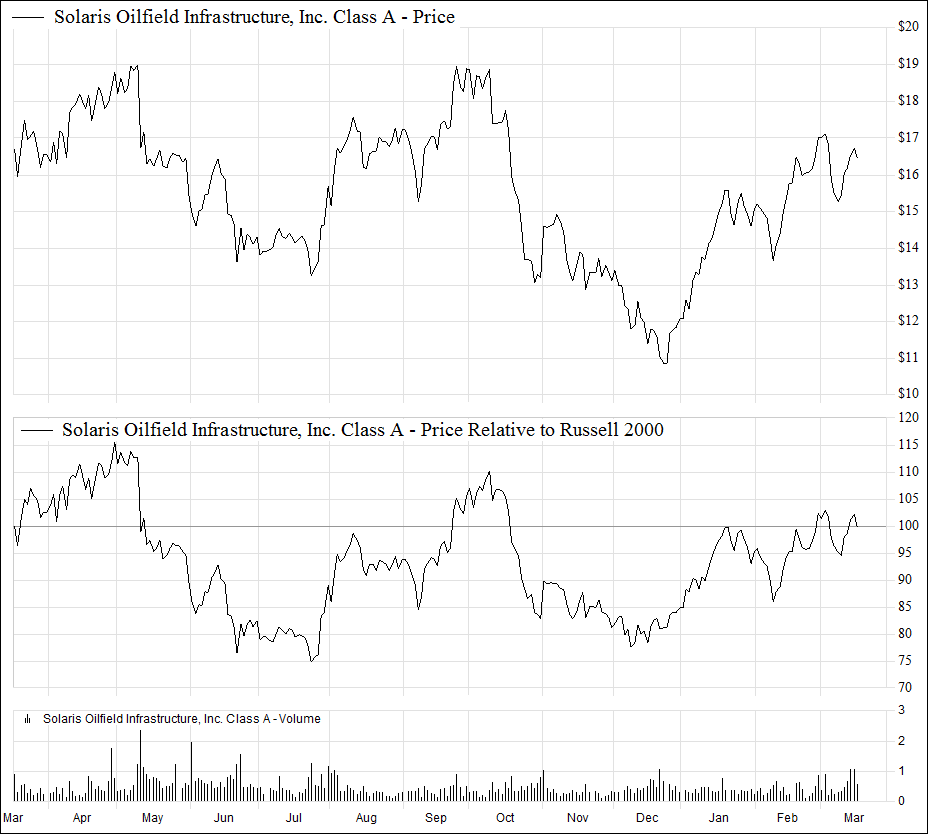
    In the beginning of December, SOI issued its first cash dividend of $0.10/share. Management felt that it was an appropriate time since they finally started turning a substantial enough profit to do so. Shareholders are starting to value profitability rather than growth for Solaris. Furthermore, the amended contract came shortly after the cash dividend announcement, negating any positive outlook from the cash dividend. Since then, shares have rebounded from near historic lows of $11.00 to $16.46, appreciating 49.6%. 

    Past Year Performance: 

    SOI has experienced a tumultuous year with the stock making strides to get back to its 52-week high. On the positive side, Solaris continually beats earnings, marking its fifth straight beat in 4Q2018.Because of the earnings beats, more analysts have upgraded their ratings with bullish sentiment. On the other hand, SOI filed for a $500m shelf registration of mixed securities in the middle of October sending the price tumbling. The price went from $19.20 to $13.50 in two weeks, depreciating 31.0%.


    Source: FactSet

    My Takeaway:

    I think AIM should continue to hold SOI and stick to the thesis at hand. SOI has exceeded expectations in terms of Sales, Net Income and EPS although the stock price doesn’t reflect that. Solaris seems to be facing headwinds from an unfavorable industry environment in the early half of 2019. Upstream budgets have been reduced but completions should hold steady. To maintain market share or to even expand it, it will come down to whether these technological advancements hold enough value of increasingly frugal upstream drillers


    Source: FactSet