Tuesday, November 7, 2017

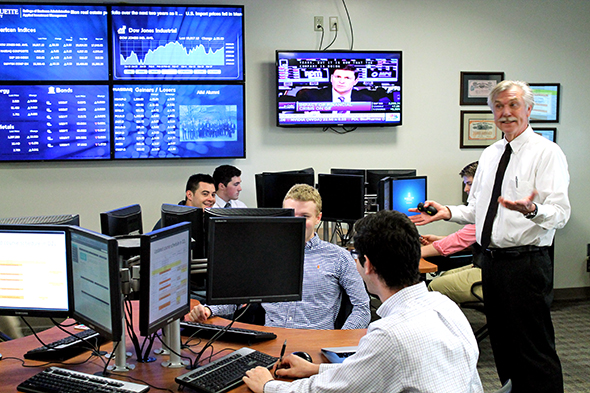
Krause, Wall and Walker - along with 18 Marquette students - attended the 2017 'Invest For Kids' Conference in Chicago on 11/3/2017

Investment Picks from the Investment Professionals Who Presented at the 'Invest For Kids' Conference in  Chicago on November 3, 2017


The 9th annual Invest For Kids Chicago investment conference was held on Friday, November 3, 2017, at the Harris Theater. Dr. David Krause, AIM program director, and Dr. Joe Wall, Accounting professor, and Bill Walker, Adjunct Instructor of Finance, took 18 students to Chicago for the event.
The students thoroughly enjoyed the event and are thankful that Balyasny Asset Management again hosted their admission to the event and the pre-conference university scholars conference at the University Club, featuring a session with Ariel Investments CEO, John Roberts. See a previous blog posting for more background on the conference. Last year's conference picks returned 22.9% in an equal-weighted portfolio over the past year.  Here are this year's picks: click each link to go to that speaker's presentation.

Still Time to Register and Attend Thursday's Milwaukee Blockchain Conference at Marquette University Sponsored by the College of Business Administration


.

DESCRIPTION

Blockchain. It’s a word that can be seen everywhere from the pages of business magazines to the websites of global professional services and tech companies. What began as the technical undergirding of the anonymous cryptocurrency bitcoin is now poised to revolutionize life as we know it by enabling the sharing of immutable contracts and records via trustless, transparent systems that remove middle men. The nascent blockchain has the potential to disrupt nearly every industry and could change the future of jobs globally for generations to come.
Join us as we bring together the area’s blockchain thought leaders for a morning of exploration on this fascinating disruptive technology.
Speakers include:
  • Marc West, Chief Technology Officer of Fiserv
  • Jennifer O’Rourke, Illinois Blockchain Business Liaison and Deputy Director of Entrepreneurship, Innovation and Technology for the State of Illinois
  • Lamont Black, Assistant Professor of Finance at DePaul University
Presentations will be followed by a panel discussion on blockchain and industry moderated by Dr. David Krause, finance professor and director of Marquette’s Applied Investment Management Program and featuring the following panelists:
  • Bob Cornell, Lead Emerging Technology Analyst at Northwestern Mutual
  • Bill Caraher, Chief Information Officer at von Briesen & Roper
  • Michael Adam, CEO of BankMyBiz.com and Founder of DocLaunch
  • Girish Ramachandra, Senior Manager for Market and Solutions at WIPFLI
  • Derek Urben, CFO and Director of Business Development at Coinigy
Doors will open at 8 a.m. for networking and a light continental breakfast, followed by presentations starting at 8:30 a.m.
The Milwaukee Blockchain Conference, an event of Milwaukee Startup Week, is sponsored by:
Questions about the Milwaukee Blockchain Conference can be directed to Heather Sullivan, associate director of external relations for Marquette's College of Business Administration, at heather.sullivan@marquette.edu.

A current AIM International Fund Holding: BAE Systems (BAESY) by Derek Grifka


Derek Grifka (BAESY, $33.17): “Aircraft Headwinds and US Tailwinds”
By: Derek Grifka, AIM Student at Marquette University


Disclosure: The AIM Equity Fund currently holds this position. This article was written by myself, and it expresses my own opinions. I am not receiving compensation for it and I have no business relationship with any company whose stock is mentioned in this article.

Summary

• BAE Systems ADR. (OTC:BAESY) is Britain’s largest defense contractor with operations in aerospace and defense and operations in cyber security. The company pays a hefty dividend of almost 4%.

• The increase in US defense spending is likely to be a major player in the success of the company.

• Disappointing Typhoon aircraft orders have caused the new CEO, as of July 2017, to cut as many as 2,000 jobs in the UK.

• An increase in electronic systems revenue from products such as flight and engine controls, electronic warfare systems, and surveillance are helping drive success.

Key points: Unfortunately, terrorism is still a threat to all countries. In response, the US government is increasing defense spending. About 39% of the BAE Systems’ revenue comes from the governments of the US, 22% from the UK, and 21% from Saudi Arabia. In early 2017, the company was awarded a $177 million contract to build a new facility at its Radford, Virginia plant. This plant will focus on the creation of smokeless gunpowder, which is projected to make its presence known again in the US defense budget. BAE is the only supplier of this product in North America.

President Trump has expressed interest in defense spending and has even grown the defense budget by over 4%, which is the fastest growth in more than a decade. Many believe that this increase will work its way to the UK eventually. Currently, the UK has not expressed too much interest in increased defense. For example, NATO demands that 2% of GDP be devoted to defense spending. While the US sits at over 3.6%, the UK dipped to 1.98% as its GDP grew faster in 2016 than its defense spending.

As for BAE’s products, almost a third of its air unit’s sales comes from the Typhoon aircraft. However, new CEO, Charles Woodburn, is cutting around 2,000 jobs (about 6% of the total UK workforce) in the production of the aircraft, since sales have been lagging. This Cold-War era aircraft has been the company’s pride and joy in the past, but times are changing and this expresses concerns about the UK’s disposition to defense spending.

This job cutting is a move towards a wider restructuring plan that could determine the fate of the aircraft as a whole. In fact, the Typhoon’s main factory in Brough, UK is losing about 400 of its 900 employees. With this many heading out of the facility, the question of whether or not to continue operations or even discontinue production of the aircraft entirely comes into play.

What has the stock done lately?

Since the announcement of the job cuts, the stock has only dropped 21 basis points as investors see the company able to focus on different aspects of the company, such as its new hybrid drones. Additionally, many see promise with the new CEO’s oil and gas background to provide a new vision and restructuring of the company as a whole.

Past Year Performance: The day Trump won the election, the stock surged over 13% because of his interest in defense spending. Since then, the stock has risen almost 23%. The stock has risen about 9% since the announcement of the new CEO in February.

Source: FactSet


My Takeaway

Terrorism will most likely never go away and there are concerns about whether or not countries have the capacity to increase defense spending. There is a greater demand for BAE’s products now, but this does not mean there will be greater profits, pending the future defense budgets of countries. There is currently a lot of pressure on the CEO to drive growth. Despite the Typhoon’s headwinds, it is possible the US could drive growth for BAE with a ripple effect that will extend overseas to Europe and beyond and ultimately feed the beast that is BAE Systems.


A current AIM International Fund Holding: Heineken NV (HEINY) by: Michael Dennison


Heineken NV (HEINY, $49.85): “HEINY at High Heights”
By: Michael Dennison, AIM Student at Marquette University


Disclosure: The AIM Equity Fund currently holds this position. This article was written by myself, and it expresses my own opinions. I am not receiving compensation for it and I have no business relationship with any company whose stock is mentioned in this article.

Summary

• Heineken NV (OTC: HEINY) engages in the manufacturing and distribution of alcoholic as well as non-alcoholic beverages. Brands include: Heineken, Dos Equis, Tecate and Strongbow. The company is the world’s “most global beer brand” with the bulk of sales coming from the United States. Heineken is located in Amsterdam, Netherlands.

• The stock has been enjoying recent success after continued sales growth and hit a new 52 week high of $53.17 last month. 

• Although domestic beer sales remain flat, growing imported beer sales remain a boon for HEINY in the United States.

• Management plans to stay active in M&A.  

Key points: Recently HEINY has been on a tear (+32.68% YTD). The firm experienced revenue growth over 5.7% in the first half of the year over the same period in 2016. A 3.9% increase in volume in the first half is the most important number here because that is that is the data point indicative of demand. The reading was a 2.6% increase in the first half of 2016. Outside the U.S. people are drinking more beer than ever as the global middle class continue to grow (+140 million people per year) and people begin to turn toward premium brands.

The United States represents a $104 billion beer market, the largest in the world. Domestic sales have been slowing (+1.8%), but this contrasts to the story being told with imported beer (+8.7%). This serves as a major boost to the world’s most global beer brand as it continues to penetrate markets with its premium, cider and non-alcoholic brands.

Management expects to continue its aggressive M&A. After finishing the purchases of both Kirin Holdings in Brazil and Punch Taverns in the United Kingdom, HEINY looks to be poised for growth in Asian emerging markets. Vietnam, which represents the 11th fastest growing market in the world for beer could be a key site for Heineken. The Vietnamese government recently announced it would divest its majority stakes in brewers Sabeco (40% market share in the country) and Habeco (18%). Vietnam represents a key launching pad for Asian emerging markets for a number of reasons. HEINY already maintains a 28% market share position in the country’s $6.5 billion market. Putting a great emphasis Vietnam would also create greater opportunity for HEINY to continue to penetrate the broader Asian markets, where 60% of the world’s population lives. 

What has the stock done lately?

After reaching a 52-week high in September, reality caught up with the company. Fears over declining consumption growth in the United States and possible tariffs being slapped on the firm’s Mexican and South American brands lead to a 5% pullback in the stock over the past month.

Past Year Performance: HEINY shares are up 15.52% over the past year. As the company continually shows sales growth overseas this trend is likely to continue. 2016 was a solid year for HEINY as the company was encouraged by solid consumption growth. 2017 is now far outpacing that of 2016 and gives claim to the stock’s recent performance described above.

Source: FactSet

 
My Takeaway

Despite the woes being felt across the broader brewing industry and declining volume growth in developed countries, HEINY continues to find new ways to compete. By positioning itself as the world’s most global beer brand, the company has diversified its market base and hedged against such developed world stagnation. With Asian emerging markets such as Vietnam poised for growth and acquisition, HEINY is perfectly set on continuing its platform. The company recently issued $800 million in long-term debt for this very purpose. I would expect to see a new 52 week high before 2017 is over.
Source: FactSet


Monday, November 6, 2017

A current AIM Program Small Cap Equity Holding: AxoGen, Inc. by Jacob Schwister


AxoGen, Inc. (AXGN, $19.46): “Axo Gen(eral) of the Industry”
By: Jacob Schwister, AIM Student at Marquette University

Disclosure: The AIM Equity Fund currently holds this position. This article was written by myself, and it expresses my own opinions. I am not receiving compensation for it and I have no business relationship with any company whose stock is mentioned in this article.

Summary

• AxoGen, Inc. (NASDAQ:AXGN) is a medical technology company focused on the science, development, and commercialization of peripheral nerve regeneration technologies. 

• AXGN maintains and develops a portfolio of nerve repair technologies that cover all surgical peripheral nerve reconstruction aspects and needs. They are the only company competing in the field.

• For FY 2016, the company had sales of $41.1M, EBIT of -$8.1M, and a net loss of $13.8M, mainly attributed to increasing SG&A expenses.

• In July 2017, the company hired Jon Gingrich as Chief Commercial Officer. Gingrich has an extensive resume including 20 years of experience in medical device sales and marketing.

• The company is continuing to attend conferences and build awareness of their products as much as possible.

Key points: AxoGen, the sole company providing peripheral nerve repair technology, has been seeing annual revenue growth from 40-60% over the past five years, and the large $2B untapped peripheral nerve repair market provides AXGN with a significant opportunity to continue capitalizing. Their portfolio of products covers all needs of the peripheral nerve repair market.

At the end of 2Q 2017, AxoGen’s products were used in 510 hospitals and surgical centers across the US, which is a 36% increase from the 2Q 2016. There are over 5,000 accounts in the United States, and the company has continued its focus on sales and marketing to continue adding new accounts to grow revenues. The growth of accounts is limited because most surgeons are cautious when it comes to using nerve repair products. They usually start out with a few cases and review the results before they fully adopt the products.
With the $2.0B market opportunity on the horizon, AXGN could see continued revenue growth of 30% well into the future. They also have been maintaining gross margins greater than 80%, which should help them reach profitability in the next few years. Profitability will be determined by the company’s ability to grow the customer base at a significant level and maintain SG&A expenses. The product portfolio is well positioned and there are significant barriers to enter the market, thus creating an optimistic future for AXGN.

If AXGN can put all the pieces of the puzzle together and continue capturing the market the company will continue to grow. With the addition of Jon Gingrich, the companies new Chief Commercial Officer, AXGN is better positioned to grow marketing and sales objectives. They are spreading the word about their products through Healthcare conferences and surgeon meetings.

What has the stock done lately?

Over the past month Axogen has been floating between $18 and $19.72 per share. The stock has increased $0.95 or 5.14% over the past month. AXGN reached its 52-week high of $19.72 on October 13, 2017. Of the analysts covering the stock, five recommend AXGN as a buy and one recommends a hold rating.

Past Year Performance: Over the past year, AXGN has performed extremely well increasing 124.20%, or $10.83 in value. The stock price’s increasing trend has been fairly steady with only one short period of decline at the end of July. Despite AXGN’s lack of earnings growth, the stock has grown steady showing investors’ confidence.

Source: FactSet

My Takeaway

Currently, AxoGen is not facing competition in a market they believe to be near $2B. They have a successful portfolio of products that they plan to continue capturing the market with. With the right strategic direction and continual marketing at healthcare conferences and surgeon meetings, they have the potential to grow their product base to more hospitals and surgical centers. The stock has seen strong growth over the past year, and this is attributed to strong revenue growth in the untapped market. It will be important to watch how potential healthcare reform could affect this company in regards to its growth in the market.


A current AIM International Fund Holding: Danone SA ADR (DANOY) by Michael Dennsion

Danone SA ADR (DANOY, $16.24): “No Doubting Danone”
By: Michael Dennison, AIM Student at Marquette University

Disclosure: The AIM Equity Fund currently holds this position. This article was written by myself, and it expresses my own opinions. I am not receiving compensation for it and I have no business relationship with any company whose stock is mentioned in this article.


 Summary

• Danone SA ADR is a multinational food and beverage company. DANOY is the world’s second largest dairy producer and third largest bottled water producer. Operating through its four segments of Fresh Dairy Products, Early Life Nutrition, Waters, and Medical Nutrition, the company collects sales across the globe. DANOY is located in Paris, France.

• After the purchase of WhiteWave Foods in July of 2016, DANOY is starting to see earnings accretion as it expands further into the U.S. organics market.

• The company recently undertook a €1.25 billion bond issue. Proceeds from the issue will be used to help refinance some of DANOY’s outstanding debt. The company will also be redeeming $500 million in WhiteWave Foods bonds due in 2022.

• WhiteWave Foods product sales saw a 17% jump in Q3 which helped push overall growth for the entire company up 4.7%.

• DANOY is encouraged by continued growth in China where the company’s Waters, Early Life Nutrition, and Medical Nutrition saw significant growth in Q3.

Key points: The purchase of WhiteWave Foods gave DANOY greater penetration into the U.S. market, a place that had previously been shrinking due to declines in consumer demand. The acquisition also gave the company a market leadership position in the organics food and beverage category, a segment predicted to grow by double digits in the coming years. Combining these two has given the company the extra “protein” it needed to push further growth.

A €1.25 billion dollar hybrid bond issue signals that DANOY is taking advantage of current economic conditions by paying down previous debt and driving further growth. The company believes that the issuance will help create a stronger capital structure for the firm, as well as aid in spurring better growth in its key markets of Europe and North America. DANOY has also redeemed a $500 million bond issuance from the acquisition of WhiteWave Foods in order to take advantage of favorable market conditions at the present moment. 

Q3 was very kind to the company as emerging market growth shone the brightest. The markets outside Europe and North America experienced YoY 11.1% during the quarter with China being a particularly bright spot. Europe remained weak with consumer demand for yogurt. Sales in North America were strong; however, the company pointed to a deflationary environment in grocery stores as a source for concern.

China was the bright city on a hill in Q3 for DANOY. The company cites higher GDP growth, an expanding childhood population, and increased e-commerce as reasons for the growth. Specialized Nutrition and Waters were the biggest winners of growth.

What has the stock done lately?

Since being added to the AIM International Equity fund in April, 2017 the stock has only climbed higher; +15.3% during that time. YTD, the stock is even better, outpacing the broader market with a 30% increase. The approval of the WhiteWave acquisition in April has helped provide bettering sentiment on the long-term growth prospects of the company and consequently helped push shares steadily higher.

Past Year Performance: DANOY shares have increased 16.58% in value during the last year. During Q3 of 2016, shares surged after the announcement of the WhiteWave Foods acquisition; however, they declined thereafter due to market sentiment about the deal and whether it would face any antitrust pressure from European or American regulators.

Source: FactSet


My Takeaway
DANOY is a company primed for further growth. The company was able to get ahead of its larger food and beverage competitors with the purchase of WhiteWave Foods, which has secured its place as a market leader in the organics space. Continued expansion into China will also be a boon for the company as the country continues to grow its middle class and its GDP. Danone will also be carried into the future by its Waters Division. Growth in bottled water is expected to increase over the medium term as consumers continue to look for healthier alternatives to alcohol and soda. DANOY shareholders stand to profit from these encouraging macro trends as the stock is currently knocking on the door of its 52nd week and looking to surpass it.  


Source:FactSet


Thursday, November 2, 2017

Eighth set of AIM student equity presentations of the fall semester will be on Friday, November 3, 2017 from 2:30 - 3:30 pm


AIM Class of 2018 Student Equity Presentations - Friday, November 3rd


The eighth set of AIM student equity presentations of the fall semester will be on Friday, November 3rd, 2017 from 2:30 - 3:30 pm.


Follow the link to review the student equity write-ups for November 3rd (Write-up) presentations.
Location:  Marquette University, College of Business Administration - Straz Hall, 1225 W. Wisconsin Avenue, Milwaukee 53233 - in the AIM Research Room 488, 4th Floor

Equity presentations will continue the rest of the semester on Friday afternoons in the AIM Room except for the following dates:
  • Road Show in Chicago on December 1st

Tuesday, October 31, 2017

A current AIM Program Small Cap Equity Holding: Insteel Industries, Inc. (IIIN) by Stephen Arcuri. "Original thesis has decayed"


Insteel Industries, Inc. (IIIN, $25.75): “Insteel, Cemented in Place”

By: Stephen Arcuri, AIM Student at Marquette University


Disclosure: The AIM Equity Fund currently holds this position. This article was written by myself, and it expresses my own opinions. I am not receiving compensation for it and I have no business relationship with any company whose stock is mentioned in this article.

Summary

• Insteel Industries, Inc. (NASDAQ: IIIN) is the largest manufacturer of steel wire reinforcing products for concrete construction applications in the United States. They manufacture and market prestressed concrete strand and welded wire reinforcement, including engineered structural mesh, concrete pipe reinforcement, and standard welded wire reinforcement.

• Extreme weather in Insteel’s largest market, Texas, is likely to delay construction and sales through next quarter.

• Any substantial infrastructure package that would be a catalyst for Insteel’s product sales seems unlikely for the foreseeable future.

• The American Institute of Architects (AIA) recently downgraded their forecasts of nonresidential construction, one of Insteel’s largest markets.

• Management has indicated that many of Insteel’s customers are dealing with labor constraints, signaling an inability to execute on top of weakening demand.

Key points: Insteel can be expected to continue to underperform through Q1 as a combination of factors come together to hurt sales. In their Q3 earnings call, management attributed their quarter to better weather in their largest geographic market, Texas. Hurricane Harvey’s displacement of workers, and continued ramifications will be a headwind for Insteel.

With no infrastructure bill on the horizon, there is no near term catalyst to boost Insteel’s sales. The passage of the Fixing American’s Surface Transportation (FAST) Act in December of 2015 proved to be a catalyst for investors, as expectations for Insteel rose with infrastructure spending. Shares further appreciated with the promise of an infrastructure bill from both the Clinton and Trump campaigns. The administration’s failure to pass infrastructure spending is not offset by the relief aid for Hurricane Harvey; Insteel’s largest product market is public, highway, and street construction, a market less affected by the flooding following the Hurricane.

In addition, the American Institute of Architects revised their nonresidential construction estimates to 3.8% in 2017, down from an original 6.7% that the original thesis relied on. 2018’s estimate of 3.6% provides no encouragement for the short-term.

Finally, in their Q3 earnings call, management indicated that customers were having difficult securing the work force required to follow through on construction projects. Part of this may be reflected in the inventory buildup that occurred in the same quarter. Insteel’s inability to move products to customers who cannot use them will be amplified by the construction break that Hurricane Harvey will have caused.

What has the stock done lately? Insteel has been in a virtual free fall since their Q3 earnings. Shares were trading just under $34 before the earnings call, and immediately fell to $25.75, a 25% decrease. After a brief rally, prices slide further and have never closed above the selloff.

Past Year Performance:

Source: FactSet

My Takeaway
The AIM portfolio should abandon its position before Insteel releases Q4 earnings on October 19th. Insteel faces an increasingly difficult market for the next both structurally, and as management noted, from increased competition. The original thesis has decayed along with the Trump trade, and with no catalysts in sight, capital could be more effectively deployed. Insteel would be worth reviewing after 1Q’18, after Hurricane Harvey has worked itself through Insteel’s cycle, or if the administration becomes serious about passing an infrastructure bill.