Monday, December 4, 2017

The Fall Semester AIM / FMA Trip to Chicago was Again a Success

Dr. David Krause and Bill Walker led 40 Marquette finance students – for the Fall 2017 FMA / AIM Chicago trip!

Fall 2017 Chicago Trip Members

Dr. David Krause (Director of Marquette’s Applied InvestmentManagement program) led 40 finance students on the annual fall semester trip to Chicago. In addition, AIM Program Executive Co-Teacher, Bill Walker, accompanied Dr. Krause - along with FMA President, Joseph Amoroso, and forty finance students as they visited asset managers on December 1, 2017. 

Dr. Krause added, “Tim Brady, Marquette’s Regional Advancement Director in Chicago joined us for the second half of the trip. It was great to have Tim given his close work with our Chicago based alumni.”

The visits on Friday included stops at the Chicago Mercantile Exchange / Chicago Board of Trade, the Union League Club and Ziegler Capital Management. The day started early as student met before sunrise for the trip down to Chicago. "We had a treat to start the morning with a visit to the CME/CBOT to visit with alumnus Jim Bianco, President of Bianco Research, and CNBC on-air commentator, Rick Santelli," Krause commented.

Rick Santelli, CNBC On-Air Editor reporting live f
rom the floor of the CME/CBOT


The students had the unique opportunity to walk through the floor of the historic exchange which has been closed to visitors for the past several years. Jim Bianco and Rick Santelli gave the students an overview of the exchange’s history and even its future, with the introduction Bitcoin futures in late December. Rick then gave students his thoughts on the Tax bill after his on-air conversation with former US Congressman– Alan Simpson.

Image result for cnbc santelli bianco
Rick Santelli and Jim Bianco at CME/CBOT

“The students really enjoyed hearing from Rick and Jim, both colorful personalities, and we thank them for working to allow the students to visit the floor and for sharing their views on the market.” Dr. Krause commented. "It was amazing that many of the students have visited both the NYSE and CME/CBOT within the past several weeks!"

Floor of the Chicago Board of Trade (CBOT/CME)


From there, the students walked over to the Union League Club on W. Jackson Boulevard, where four AIM students pitched stocks and we were joined by recent AIM graduates, Steve Hoffman, Anthony DiSanto, and Casey McClelland. All AIM write-ups can be found here.


                          MU Students, Adam Hamilton and Ronnie Terry, 
                      pitching a stock at the Union League Club in Chicago 


AIM Equity Presentations Friday, December 1, 2017
Presenter Sector Company Name Ticker Protogee
Adam Hamilton Intl Financial BBVA Banco Frances S.A. BFR Ronnie Terry
James Hannack REIT QTS Realty Trust QTS Nick Tenuta
Brian Holland Intl Healthcare Alkermes PLC ALKS Nick Longo
Jacob Schwister Healthcare Aclaris Therapeutics ACRS Jack Senft


MU Students, Jacob Schwister and Jack Senft,
pitching a stock at the Union League Club in Chicago

Dr. Krause said, “The students and our guests enjoyed a nice working lunch as two international and two small cap stocks were pitched. We also enjoyed our two keynote alumni speakers: Tom Digenan, Head of US Intrinsic Value Equities at UBS Asset Management, and Jim Bianco, President of Bianco Research. They spoke to the students about a range of topics including financial bubbles. Both our speakers has very pointed and experience-driven remarks to share with the students that I know they all found to be both interesting and valuable.”


Tom Digenan of UBS spoke to the Marquette students


Tom Digenan (UBS) spoke to students about his experience during previous asset bubbles and identified ways to look for potential bubbles in the markets. Additionally, with numerous AIM students taking the CFA Exam on Saturday 12/2, Tom, who is actively involved with the CFA Society of Chicago, shared information and material about the Chartered Financial Analyst designation.

The Marquette University AIM Program is a CFA Partner Program and incorporates the CFA body of knowledge into the programs curriculum. The AIM Program was the first undergraduate program to be labeled a Partner Program ofthe CFA.

Jim Bianco, President of Bianco Research, 
speaking to students at the Union League Club


Jim Bianco has frequently joined Dr. Krause and the AIM students at the Union League Club as a keynote speaker. Jim spoke about the rapid advancements of technology and how that is rapidly reshaping our world and the investment industry. He also elaborated on his comments from the CME/CBOT regarding bubbles in the markets and the future of Bitcoin.

Dr. Krause said, “It was a pleasure to hear from both Tom and Jim. They possess a wealth of experience and knowledge and the students always gain immensely by hearing from them. We are at a volatile point in the financial markets, it is so valuable to hear from two individuals with their fingers on the pulse of the market and the economy.” 
Image result for scott roberts ziegler
Scott Roberts of Ziegler and Dr. David Krause


From the Union League, students made their way over to Ziegler Capital Management where they were hosted by Paula Horn, Chief Investment Officer, Senior Portfolio Manager, and Daniel Kralovec, Associate and AIM alumnus. Ziegler is led by Scott Roberts, Marquette alumnus and current member of the University's Board of Trustees.

Paula Horn, CIO and Senior Portfolio Manager at Ziegler   


During our visit to Ziegler, the students had the opportunity to hear from two fixed income portfolio managers and Donald Nesbitt, Chief Investment Officer — Select Equity Group, Senior Portfolio Manager. Both teams walked students through their process as well as their current views on the markets and the economy that are driving their securities selection decisions.

“It was a pleasure to visit Ziegler Capital Management. The firm has long been a strong supporter of the AIM Program and Marquette University. This was an excellent opportunity for the program's younger students to hear from real world portfolios managers in both fixed income and equities. We are thankful for Scott and Paula for their support and the opportunity to visit the firm,” Krause commented.

Dr. Krause said, "This was again another outstanding trip – and it was all made possible through the support of our Chicago based Marquette alumni and friends. We are all extremely thankful for this opportunity to visit Chicago each fall. Our alumni are fantastic – they go out of their way to open up their firms and organize special visits. These opportunities afforded our students a view into the history of modern finance as well as the workplace and corporate culture - it is an amazing opportunity for our students." 


A current AIM Program Small Cap Equity Holding: Planet Fitness (PLNT) by: Connor Konicke. "Thumbs Up For Planet Fitness"


Planet Fitness, Inc. (NYSE: PLNT, $30.22): “Thumbs Up For Planet Fitness”

By: Connor W. Konicke, AIM Student at Marquette University


Disclosure: The AIM Equity Fund currently holds this position. This article was written by myself, and it expresses my own opinions. I am not receiving compensation for it and I have no business relationship with any company whose stock is mentioned in this article.

Summary

• Planet Fitness, Inc. (NYSE: PLNT) franchises and operates fitness centers across the United States with recent expansion into international markets. PLNT offers a unique and highly attractive business model, with a high-quality fitness experience while providing a welcoming and “non-intimidating” environment called the "Judgement Free Zone".

• PLNT reported 3Q2017 earnings after market close with a 12% top line beat, boosting 3Q2017 revenue to $97.5 million, exceeding analyst’s expectations of $93.6 million. The 3Q2017 earnings call marked PLNT’s 43 consecutive quarter of same store sales. In addition, PLNT beat EPS consensus estimates by 18% to $0.19.

• Management increased full year guidance with revenue expected to be between $425-430 million vs. prior guidance of $409-415 million, with same store sales between 9.5-10% and full year EPS between $0.80-$0.82.

• PLNT opened 31 new stores in 3Q2017, bringing the total store count to 1,432. PLNT is looking to achieve 190-200 stores per year for the next five years with a long term target of 4000+ stores in the United States and 300 stores in Canada.

Key points: PLNT continues to deliver consistent earnings and revenue beat with exceptional growth coming from PLNT’s franchise segment, which currently reports ~82% EBIT margins. While the stock has risen 65% since PLNT’s IPO in August of 2015, and ~50% since the start of the year, PLNT continues to have several catalysts to drive share price. Three catalysts that will continue to allow PLNT to outpace the market are international expansion, black card memberships and fragmentation within the United States market.

PLNT has been expanding into Canada since 2014, but more recently noted expansion into Panama. As PLNT continues to be successful in the Canadian market and with an assumed long term target of 300 stores, PLNT will need be assertive and thorough in evaluating new markets as they continue to expand. While failure to expand successfully into new markets would burden PLNT’s expansion hopes and overall profitability of the company, management was positive regarding the success thus far on the 3Q earnings release, stating presale memberships have been extremely strong internationally.

Secondly, PLNT has significant pricing power over peers and has recently increased their highest priced and most bought membership (Black Card membership) from $19.99 to $21.99, because of positive response to consumer’s price elasticity. The Black Card membership rolled out on October 1, 2017 and will continue to provide incremental profitability to the company, especially heading into 4Q2017 and 1Q2018, the two busiest quarters for PLNT. Despite the price increase, the membership offers a significant discount relative to peers considering the benefits it provides.

Lastly, PLNT will need to continue being a market leader and establish its presence within their largest market, the United States. Although there is uncertainty around the long term target, PLNT needs to focus on finding the right markets and opportunities for store growth to be accretive. Over-expanding into local markets that lack the ideal demographics would pressure margins and cause investors to wonder about the effectiveness of managements ability to scale growth.

What has the stock done lately?

Since the addition of PLNT to the AIM Domestic Small-Cap Fund on September 19, 2017 at a cost basis of $26.01, the stock has gained slightly over 16% to $30.22 as of market close on November 15, 2017. The stock fluttered within the $25.00 to $27.00 range, as technical resistance bands limited the stocks appreciation until PLNT’s 3Q earnings call after market close on November 7, 2017. PLNT beat street estimates, reporting an EPS of $0.19 vs $0.16 and raising full year guidance. The stock followed with a 17.35% appreciation.

Past Year Performance:
PLNT has been one of the hotter small-cap domestic consumer discretionary stocks on the market that Amazon has not been able to penetrate. PLNT is up ~50% YTD and ~26% over the one-year period. The stock has been held down by significant short (15-20% of float), but continues to show its ability to thrive in the consumer market.

Source: FactSet


My Takeaway
Chris Rondeau and his team continue to outpace the market and prove the effectiveness of their unique business model. With full year guidance raised, increased pricing on membership’s due to positive responses from customers, and significant opportunities within the US and internationally, I believe that Planet Fitness has significant room for upside. I recommend that the AIM Small Cap Equity Fund should continue to hold PLNT.

Source: FactSet


A current AIM Program Small Cap Equity Holding: Brookfield Property Partners LP (BPY) by Joe Flynn. "Superior Assets that are Globally Diversified"

Brookfield Property Partners LP (BPY, $23.33): “Strong Fundamentals & Contrarian Investments Driving Outsized Returns for BPY”

By: Joe Flynn, AIM Student at Marquette University


Disclosure: The AIM Equity Fund currently holds this position. This article was written by myself, and it expresses my own opinions. I am not receiving compensation for it and I have no business relationship with any company whose stock is mentioned in this article.

 Summary

•Brookfield Property Partners LP (NYSE: BPY) is Brookfield Asset Management’s (68% OS) primary vehicle for property investing globally. The company owns and manages an attractive real estate portfolio consisting of high-quality, trophy-like assets and conducts investments within three segments; Core Office, Core Retail, and Opportunistic. 

•Consistent FFO growth, and 5% yield have made little to no impact on its average 28% discount to NAV. REIT Conversion on hold for now.

•Capital recycling efforts currently at the mid-point of $100-200M target, flexibility encouraging investment in opportunistic strategies with strong return potential. Continued unit buybacks a plus.

•High-quality Core Office & Retail assets leading to stable cash flows. Making good progress adapting to pressured retail space, and opportunities in low-valuation environment will lead to continued involvement. Deployment pipeline and lease momentum driving meaningful growth in office portfolio.

Key points: Brookfield Property Partners operates as a limited partnership and has upheld a strong track record of generating returns through its value-oriented investment approach. After reporting 2Q17 earnings, BPY continues to show its strength despite a pressured retail space. BYP increased FFO 2% in 2Q, which makes the 9th consecutive quarter of YoY FFO growth. The company also has maintained consistent same store growth in the range of 2-3% and has grown annual distribution in line with the target of 5-8%. The current 5% yield is backed by solid cash flows from the retail and office core portfolios. The opportunistic portfolio has begun to show its high return potential as well, with now over $5.2B invested (20% of assets).

Over the past year, it was unclear whether BPY would continue their LP. or decide to pursue a REIT conversion. At BPY’s Investor Day in September it was confirmed that the firm is no longer actively pursuing REIT conversation, but was not ruled out entirely. The current LP structure allows BPY to continue recycling capital without major restriction.

Through its capital recycling efforts, BPY raised $825M of equity capital in the first two quarters of 2017, and additional $815M is expected from asset sales during the 3Q. Recently, a larger portion of recycled capital has been allocated to its opportunistic fund to capitalize on mispriced assets with operational upside. The opportunistic fund invests in high-quality, globally diversified private equity sponsored funds that generally earn +20% returns. The portfolio should continue to grow to $7M assets by 2018 and self-fund future investments in similar strategies.  The company also put capital to work to buy back $253.7M worth of units during 2017, reducing OS by 4%. The undervalued share price will likely lead to continued focus on buybacks in upcoming quarters.

Retail is the most hated investment space today, and negative headlines continue to dominate. As contrarian investors, BPY sees the negative sentiment as an opportunity to invest further. BPY has payed close attention to the challenges/trends facing retail, and has adapted its core portfolio accordingly to remain 95% occupied. BPY has yielded 8-10% by redeveloping traditional department store locations into higher revenue generating uses such as entertainment, restaurants, and omni-channel stores. BPY has also capitalized on e-commerce brands that are expanding to brick-and-mortar to widen customer base, and signed leases with retailers Bonobos, UNTUCK it, and Warby Parker. The company recently increased its position in General Growth Properties to 34% OS.

In addition, APY’s core office portfolio continues to be one of the most highly regarded, and premier office portfolios in the world. BPY’s active deployment pipeline with expected deliveries of $7.5M SF should meaningfully impact NOI going forward. Leasing momentum has also picked up this year, most notably for the Manhattan West Development Site. In 3Q, BPY signed leases with Amazon and EY bringing the tower to 82% pre-committed.

What has the stock done lately?

The only major movement in the past couple months occurred on October 4th, where the stock jumped 5.5% in one trading day to $24.80 following an article published by Reuters. It was reported that BPY was considering a partial sale of its Northeastern Office portfolio for $10B. BPY has been able to take advantage of high valuations by selling certain core properties, but since the stock declined to its current level today.

Past Year Performance:

BPY has been able to perform well in the wake of the market’s deterioration of its retail portfolio. Retail represents approximately ½ half of invested assets, and 34% interest in GGP continues to affect sentiment. Despite the retail portfolio being off by over 20% YTD, the shares have still managed to rise by 6%. The stock has also outperformed the MSCI US REIT index by 4%. The LP business model makes the stock a unique real estate vehicle, but is not widely followed and excludes billions of $$ in index money from chasing it.


Source: FactSet

My Takeaway

Finding a real estate company with superior assets that are globally diversified like BPY’s core portfolio is hard to come by. The shares still trade at a 23% percent discount to its $29 NAV, but management’s involvement is encouraging, and the buyback should set a floor for the stock at around $23 in the meantime. The company’s strong FFO growth and 5% yield has yet to narrow the discount gap, but supports future capital appreciation of its stock when retail turns around.  It may take some time to play out but returns of +20% in opportunistic strategies give BPY strong risk/return characteristics and will complement stable cash flow from the core portfolios. Management is targeting after tax returns of 12-15% per year on its invested capital looking forward. It is recommended BPY is held in the AIM fund with its original target price of $28, and offers outsized-return potential in today’s benign environment.  

A current AIM International Fund Holding: CryoLife, Inc. (CRY) by Tim Donovan. "Can CryoLife Buy Its Way Into Europe"

CryoLife, Inc. (CRY, $19.05): “Can CryoLife Buy Its Way Into Europe?”

By: Tim Donovan, AIM Student at Marquette University


Disclosure: The AIM Equity Fund currently holds this position. This article was written by myself, and expresses my own opinions. I am not receiving compensation for it and I have no business relationships with any company whose stock is mentioned in this article.

  • CryoLife, Inc. (NYSE: CRY) is a medical devices company involved in the processing and distribution of implantable tissues used in cardiac and vascular surgeries.
  • CryoLife generated $180.4MM in revenue throughout 2016 from the sales of its extensive portfolio including products such as BioGlue, BioFoam, On-X, PerClot, and several more in the area of cardiac and vascular tissue preservation.
  •  On October 10, 2017 CryoLife entered into an agreement to purchase Germany-based JOTECH AG for a total of $225MM (75% cash, 25% stock). The acquisition is set to close by the end of 2017.
  •  JOTECH is focused on the development of endovascular stent grafts as well as cardiac and vascular grafts with a focus on aortic repairs. Over the past 5 years JOTECH has seen a CAGR of 17%.
  • The acquisition provides CryoLife access to a $2B global market for endovascular stint grafts. The market it projected to grow to $2.5B by 2021.


Key Points:

CryoLife has an impressive portfolio of products from both development and acquisition. Since its inception it has grown a list of 11 products, including some duplicate versions for international sales. Having expanded into Canada, Europe, and parts of Asia, they still derive 76% of overall revenues from the United States. With increased competition inside of the United States, international expansion is becoming a viable option to sustain overall growth for the company.

With its current focus on sealants and tissue regeneration, the company has looked for other markets to break into. With international expansion and product line growth in mind the company announced the acquisition of Germany-based biotechnology company JOTECH. This privately held company focuses on the manufacturing of endovascular stent grafts for aortic repair. This segment of medical devices has a potential addressable market of $2B. This inorganic introduction into this industry will give CryoLife an opportunity to not only partake in the aortic repair business, but also expand its footprint in Europe. A main driver that pushed the business into Europe were the costs of selling through international distributors. By having a wholly owned subsidiary in Germany, CryoLife will have an easier opportunity to try out a direct sales method to people throughout continental Europe. In the last quarter the company announced that it is now selling directly to customers in Canada, Belgium, Luxemburg, and the Netherlands, with the hopes of one day having a direct market in the rest of the continent.

While this acquisition provides an opportunity to move further into the European market, it comes at a cost. $225MM was the settled purchase price for JOTECH. Of this 75% will be cash, and the remaining 25% will be stock. The stock portion of the acquisition represents $56.75MM, or 2,682,403 shares of common stock. The company expects this recent acquisition to provide a CryoLife an EPS CAGR of above 20% over the next 5 years.

Despite significant opportunity in the European countries, CryoLife could face some difficulties in this expansion. With limited experience in European markets CryoLife will be taking a large stake in a part of the world they are not accustomed to. If they are unable to successfully transition into the European market the overall profitability of this acquisition will be strained or even eliminated.

What has this stock done lately?

2017 has not fared as well on CryoLife as expected. Posting 9 month revenues of $136.9MM fell short of expectations, representing a 1.13% change YoY. Despite slower top line growth management was able to improve efficiencies, raising their gross margin to 67.4% up from 64.7% in 2016.

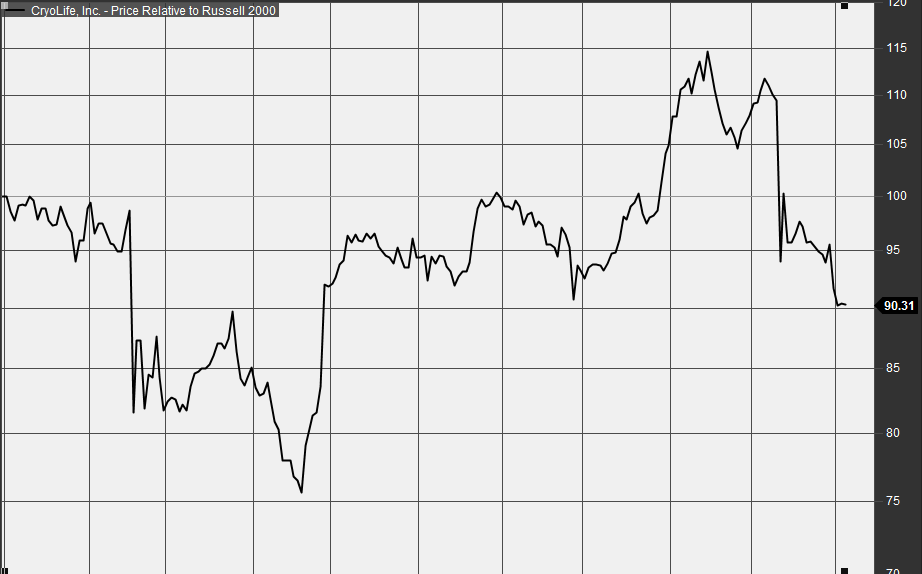
Despite significant movement throughout the year CryoLife is trading up 0.26% since the beginning of January. Throughout this time it has seen troughs as low as $14.60 in April, and peaks as high as $23.85 in October.

On Monday October 30th Cryolife announced Q3 EPS of $0.08, falling $0.01 short of the targeted $0.09. On top of this their revenues came in at a modest $44MM, representing a -2.8% change YoY. This resulted in a missing of revenue projections by $1.65MM. Having significant exposure in the Florida and Texas markets, recent hurricanes in September and October have resulted in around $1MM in lost revenue during this period. On top of this they had a delay in the receipt of Ascending Aortic Prosthesis, resulting in a $1.1MM repurchase of inventory from third-party distributors.

YTD Price - Source: FactSet

Price Relative to Russell 2000 - Source: FactSet


Key Takeaways:

CryoLife has seen some headwinds in their domestic operations. Increased competition and lagging revenue growth numbers have pushed the company to make alternative moves. With the acquisition of JOTECH, CryoLife has an opportunity to drive sales abroad in both their existing market segment, as well as their recently acquired aortic repair segment.


Going forward I believe that a direct selling method in Europe along with an introduction into a new market segment will help stimulate further top line growth for CryoLife. Despite this opportunity, they need to still remain focused on domestic sales to maintain market share within the United States. This teamed with the risk of international expansion still pose some threats to CryoLife. Due to a balance of risk and reward, I recommend that CryoLife, Inc. remain held in the AIM Small Cap Portfolio while their international expansion plays out.