Sunday, June 30, 2013

Op-Ed: It's time for the Federal Reserve to act independently

About 100 years ago, President Woodrow Wilson asked Congress to create the Federal Reserve System, which set off a fierce debate. Critics predicted that the Federal Reserve would become an economic dictator - an “invisible government by the money power.”

At the last Fed news conference, chairman Bernanke spoke of his timetable for scaling down quantitative easing  “If things are worse, we will do more,” he said of the nation’s economy. “If things are better, we will do less.” Talk about decisiveness! 

The debate about the role of a central bank in the U.S. has been raging since the founding of the country – and even today the Tea Party seeks to eliminate the Federal Reserve.

Is the Federal Reserve too strong? Is it now the all-powerful central authority that Americans feared it would become? Is it independent of the “money trust” it was created to tame?

These questions – and others - are being debated in op-ed pieces and faculty lounges across the country. I'm weighing in as well.

Bernanke said  “If things are worse, we will do more. If things are better, we will do less” when talking about the future course of monetary policy. For several days following his remarks, the financial markets tanked - stocks, bonds, commodities, and everything else. The markets' short-term hostile reaction to the prospect of a measured end to easy money should not make it harder for the Fed to reverse course. The Fed should act independently.

Like a trainer teaching a puppy, the Fed should follow through on its orders and remain in charge – not succumb the wishes of markets. Certainly during the financial crisis, the Federal Reserve had to step in and restore order – I think they saved the day.  

Since then, the super low interest rates and easy money drove investor funds into risky assets and sent prices higher, restoring bank and investment company balance sheets. Unfortunately the policy did not directly benefit the lives of the working class or seniors – as credit dried up and savings rates dropped to near zero. The bad actors got bailed out.

The Fed should follow through on a plan to taper down quantitative easing and allow the economy to function on its own by 2014 – despite the temper tantrum the markets will throw.  The economy can stand on its own two feet and its time to get back to normal - or at least its time to stop artificially holding interest rates below market equilibrium.


Saturday, June 29, 2013

Rising College Seniors: Begin Your Job Search Now!

From the Undercover Recruiter site:

As rising college seniors approach the beginning of their last year of undergraduate study, they have a lot to think about besides exams and their social life. What they’re planning to do after college life is still a question left unanswered for many.

For those soon-to-be graduates seeking employment, Beyond.com conducted a poll, asking college seniors in their last semester how many jobs they had applied to. Here’s what the results showed:
• More than 33 percent reported they applied for over 40 jobs
• Just about 21 percent of respondents applied for somewhere between 10 and 20 jobs
• Almost 20 percent have applied for 21 to 40 jobs
• 17 percent have applied for less than 10 jobs
• The smallest percentage, 8.5 percent, applied for no jobs at all

While the economy is looking much brighter for recent college graduates than it has the past couple years, it still takes that extra something to help young job seekers stand out among the other applicants. Here are some tips to help college graduates be at the top of their games and score entry-level jobs in their fields.

1. Clean up your online image
Yes, employers do Google applicants. Make sure there’s nothing out there you wouldn’t want an employer to see. This includes ensuring your Facebook and Twitter privacy settings are intact and/or change your accounts to be employer-friendly to ensure you’re only viewed as a professional.

2. Start applying now…if you haven’t already
The earlier the better. Many employers start looking for candidates 6 months or more before graduation, so they are ready to fill the positions in May or June. Try to get ahead of the flood of resumes by applying early and often.

3. Don’t be afraid to network – in person and online
Every opportunity is an opportunity to network! Whether it’s chatting with a professor, staying in touch with an internship coordinator or creating a LinkedIn profile – don’t be afraid to put yourself out there professionally. The worst thing that can happen is nothing. Many people say landing a job is “all about who you know.” Well, the more people you are connected with virtually and in-person, the more chances you have of hearing about an employment opportunity.

4. Target your job search
While not every opportunity is going to be your dream job, you can target what you want if you find job postings in a niche job board or LinkedIn group. For example, if you’re looking for finance jobs, find a place where these types of jobs are posted specifically. Niche job boards offer more targeted job search results and a greater variety of relevant job opportunities.

5. Download mobile job search apps
Everyone is attached to their Smartphone these days, so why not receive job alerts and do some job-searching on the go?

6. Utilize your school’s career services

It’s likely that your college or university has a career services office. Some schools also offer further training like a project management certificate or other classes to deepen your education. While you’re still a student, make use of these services by making an appointment to have your resume critiqued or do a mock interview. Also, join a professional student organization or participate in groups/activities on campus that are good resume builders. For example, if you’re a finance major, you should join Financial Management Association (FMA) - and be active.

Thursday, June 27, 2013

Blackrock's Fixed Income CIO Talks About the Normalization of Interest Rates


Rick Rieder, BlackRock's Chief Investment Officer of Fixed Income, was the speaker at this year’s Make a Difference –Wisconsin conference in May. He’s one smart fellow and when he talks, it makes sense to listen.

In his recently published June newsletter, Mr. Rieder acknowledges that the Federal Reserve has ‘crossed the Rubicon and is headed toward a normalization of interest rates’. The following is a summary of his observations.

  • The Federal Reserve’s task in recent years (supporting the economic recovery, in the absence of sustained fiscal aid) has been tremendously challenging, but despite much criticism, its successes are significant.
  • The eventual withdrawal of Fed asset purchasing (which he believes is nearer than other prognosticators) should keep market volatility levels elevated (and fixed income pricing under pressure), but it is also a signal of economic gains.
  • In this context, he believes that investors should be more tactical in searching for opportunities, focus on liquidity, and mitigate interest rate risk via a shorter duration approach.

Like one of my other fixed income favorites, Dan Fuss, Rick Rieder is a straight-shooter who calls them like he’s sees them. His statements are pretty clear – he sees an ending of QE3 and the normalization of interest rates. I can't say I disagree with him.

The Supreme Court’s ruling yesterday on DOMA affects same-sex couples' financial planning

A pair of Supreme Court rulings Wednesday will bring major changes for financial advisors who work with same-sex couples.
The U.S. Supreme Court's decision declaring part of the Defense of Marriage Act (DOMA) unconstitutional likely will have a big impact on financial planning for same-sex couples. The ruling gives gay couples access to more than 1,000 federal benefits in 12 states and the District of Columbia, where same-sex marriage is legal.
There is still uncertainty about the ruling. It is supposed to take effect immediately and possibly even retroactively, which means that financial advisors and employers will have to reprogram tax reporting systems and update forms for enrollment, distributions and beneficiary designation, and more.
Key federal financial benefits available in the states that allow same-sex marriage include the right to:
·        -  Transfer property to a spouse during one's lifetime without owing federal gift tax.
·       -   Receive property from a deceased spouse without paying federal estate tax.
·        -  File federal taxes jointly.
·      -    Receive a spouse's Social Security benefits.
·        -  Receive pension survivorship benefits.
·         -  Eligibility to use federal Family and Medical Leave Act to care for spouse.
More details on the changes in benefits can be found here.

The justices' ruling on the Defense of Marriage Act allows the Obama administration to take executive action to broaden benefits in states where gay marriage is not recognized. In summary, financial advisors and planners will need to understand the implications of yesterday’s Supreme Court decisions as to how it affects past, present and future financial decisions of their clients who are affected by the rulings.

Listening Better Might Help You Land the Job

From ‘Listening facts you never knew’ by Kristin Piombino in Ragan’s PR Daily:

Do you want to be hired? Do you want a promotion?  If so, you may want to reevaluate your communication skills - especially your listening skills.

According to subscribers to the Harvard Business Review, they rated the ability to communicate "the most important fact in making an executive promotable." They ranked it more important than ambition, education and hard work.

The graph below lists other statistics about communication and listening. For example, did you know that we derive 55 percent of a message's meaning from the speaker's facial expressions, 38 percent from how he says the message and 7 percent from the actual words spoken?

Here are a few more facts: 

  • We listen to people at a rate of 125-250 words per minute, but think at 1,000-3,000 words per minute.
  • Less than 2 percent of people have had any formal education on how to listen.

Images go into your long term memory, whereas words live in your short term memory. During an interview, focus on listening. Make notes if necessary - and understand that listening might be just as important as talking. (Click on the image below to enlarge).


Wednesday, June 26, 2013

FIVE THINGS TO SAY IN A JOB INTERVIEW by NOLA GREEN

From the Come Recommended site:

"You always hear about what you shouldn’t say in an interview, but what should you say? What are those tid-bits you should mention that will set you apart from the rest? Here are a few that I found helpful:

That you actually want the position: This little tidbit could be the one thing that sets you apart from the other candidates. Don’t play it cool and aloof in this situation. If you are eager to be hired for the position, LET THEM KNOW. But remember to always be prepared to tell them why. Alison Doyle tells you more here.

Your familiarity with the company: Expressing your familiarity with the company you are interviewing with is a great way to SHOW the employer how interested you are and how invested you will be in your job, without actually having to say exactly that.

Good buzzwords: Whenever you are asked a question about yourself, like what skills do you possess, or do you think you are a team player, make sure to use your buzzwords. Collaborative, innovative, pro-active, drive, cooperate, team ethic, contribute…these are all great words to use. Come up with a few of your own that you feel really describe you, and make sure to use them in an interview. You can find a lot more information on buzzwords and how to use them here.

Future plans: If you have the desire to really build a career in one company, make sure to mention that in your interview. No company wants to invest time and money in you to have you leave after three years. That being said, if your future plans involve using this job as a springboard to launch you acting/singing career, it’s probably best not to mention that.


Ask questions: When asked at the end of an interview, NEVER say no. Always have some questions up your sleeve. Usually two or three questions would be sufficient. Questions should be centered on the company, and again show your interest. If you have noticed that they have won several awards, ask why they think they have that edge."

U.S. Housing Prices Increased More Than Forecast in April

Stronger housing market shows more evidence that the U.S. economy is back on track

During the past several years I’ve told my students and others that one of the most important indicators of economic activity to watch is the housing index – and that when this showed a rebound, the economy would be back on track. Well, the S&P/Case-Shiller index of property values, which was released yesterday, increased 12% percent from April 2012 to April 2013, the biggest year-over-year gain since March 2006. The average home price climbed more than forecast and showed further strength in the U.S. housing market.

The reason for the rise is simple: housing is in short supply, we’ve had record-low mortgage rates, and there is an improving job market.  The question that remains is whether or not the U.S. economic recovery is far enough along to overcome the recent surge in borrowing costs after Federal Reserve officials said they may trim unprecedented accommodative monetary measures meant to spur the economic expansion. I believe it is.

From Calculated Risk


The graph shows the year-over-year change in the Case-Shiller Composite 20 Index (a measure of sales activity in 20 major U.S. cities) is up 12.1% compared to last April – marking the 11th consecutive month with a year-over-year gain. That’s an amazing rise of essentially 1% per month. In April alone, the index logged a 2.5% gain in home values compared with March, the fastest gain in more than six years of tracking. 

Not all cities see equal gains. The biggest gainers over the past year have been those markets that were the hardest hit: Atlanta, Detroit, Las Vegas, Los Angeles, Phoenix, and San Francisco all posted price gains between 19 and 24 percent.

The next chart shows the nominal seasonally adjusted Composite 10 and Composite 20 indices. The indexes are off about 25% from the peak and up about 13% form the post bubble low set in Jan 2012. While the increase does not look dramatic, it clearly marks that we've turned the corner regarding the housing market in the U.S.

From Calculated Risk


Tuesday, June 25, 2013

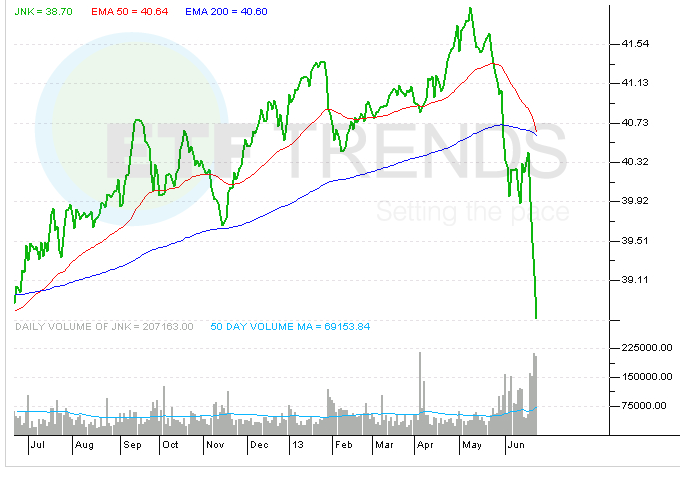
Where did all the gains go? High-yield and preferred stock 2013 profits go up in smoke!


Many investors flocked to the high-yield bond and preferred stock ETFs during the past year and saw strong returns. In May, Federal Reserve Chairman Ben Bernanke gave a warning to these investors. He said the Fed was keeping close tabs on signs investors were taking on more risk to generate income with interest rates so low.

“In light of the current low interest rate environment, we are watching particularly closely for instances of ‘reaching for yield’ and other forms of excessive risk-taking, which may affect asset prices and their relationships with fundamentals,” Bernanke said.  Since that statement, the funds have seen their year-to-date gains wiped out - and more.

For example, SPDR Barclays High Yield Bond ETF (NYSE: JNK) is off 2.5% so far in 2013 and iShares U.S. Preferred Stock ETF (NYSE: PFF) is down 1.8%. The recent sell-off as Treasury yields surge has resulted in losses of about 6% over the past month for both funds. [Check out the charts below].

Stretching for yield is dangerous. With yields on the 10-year Treasury bond up about 100 bps in the past two months, bond investors in higher risk products such as the PFF, the preferred share ETF (currently paying a 30-day SEC yield of 5.3%) and JNK, the high-yield fund (paying 5.6%) have been clobbered.

They can't say they weren't warned...


SPDR Barclays High Yield Bond ETF


iShares U.S. Preferred Stock ETF