Sunday, February 11, 2018

A current AIM Program Small Cap Equity Holding: LendingTree, Inc. (TREE) by: John Wagner. "Does Money Grow on TREE(s)?"


LendingTree, Inc. (TREE, $370.60): “Does Money Grow on TREE(s)?”

By: John Wagner, AIM student at Marquette University


Disclosure: The AIM Equity Fund currently holds this position. This article was written by myself, and it expresses my own opinions. I am not receiving compensation for it and I have no business relationship with any company whose stock is mentioned in this article.

Summary

LendingTree, Inc. (NASDAQ:TREE) is the leading online loan marketplace connecting  consumers to over 450 lenders that offer student, personal, mortgage, automobile and other related types of loans. 

• TREE is continuously developing their MyLendingTree platform and investing in technology to conquer the digital gap in the mortgage industry, while working with lenders to provide consumers with training, information, and a better overall customer experience.  

 LendingTree has diversified their mortgage/non-mortgage revenue mix to about 45%/55% v. 65%/35% just two years ago. This diversification should continue to contribute to their 5-yr revenue CAGR of  41%.

• With a TAM worth over $19 billion and only a 30% market share, TREE looks to continue expansion through acquisitions and development of non-mortgage segments.

Key points: Lending Tree is back on track following its spin out in 2008. Following their decline, large amounts of M&A and internal development has occurred, creating over 50% growth since 2015. Management has placed emphasis on not only diversified product portfolio but conforming to needs of millennials, who are growing faster vs. peers. These millennials, who are technology dependent, will make use of all TREE has to offer, not only loan related, but also for filing taxes.

In it’s most recent M&A deal, LendingTree acquired Roostify, a leader in the real estate lending marketplace. Nikul Patel, Chief Strategy Officer of TREE, proposed that this acquisition will not only make matching lenders with consumers more seamless, but allows for loans to be completely digital in this segment of their business. Combining these two platforms allows for loans to be found, filed, and closed completely digitally. In essence, this new acquisition will diversify their product portfolio as well as make loans simple, paperless, and fitting for millions of people, especially millennials.

With that being said, it will be interesting to see how management reacts to the current mortgage industry, and home sales specifically. According to the National Association of Realtors, the number of homes on the market have hit an all time low, meaning consumer mortgage demand could be adversely impacted. Management claims that in their current product portfolio, a decline in purchase demand will be recouped with refinancing; that they are not worried about the current state of the mortgage industry.

Also to note, Purcell Julie & Lefkowitz LLP, a law firm committed to representing shareholders , has launched an investigation against LendingTree, Inc. for its potential breach of fiduciary duty. Pending results of the investigation, shareholder wealth could be largely impacted if it is found that TREE did not reach their fiduciary responsibility. There has been no more information released to this point.

What has the stock done lately?

The stock has just recently dropped ~10% from it’s 52 week high, $404.40, to now $362.25. This dip occurred on January 23rd  primarily as a result of overnight trading volatility. Since this dip, TREE is up 2.3%, to a current price of $370.60. 4Q-17 earnings are to be released February 22. 

Past Year Performance: Following four major acquisitions in 2017, as well as continuous development to its MyLendingTree app and platform, LendingTree, Inc.’s stock is up 227% this year. TREE has also hit its all time high stock price of about ~$404, however, it is now currently trading around $362. While TREE has beat consensus estimates twice in 2017, 4Q earnings could be very indicative of their position in the current market.

 Source: FactSet

My Takeaway

Management is a key factor in the continued success of LendingTree, Inc. Founder, Chairman, and CEO Doug Lebda has been with TREE since its IPO in 2000. After a series of ups and downs, it has ultimately prevailed on top. With continued technological development and expansion across both its mortgage and non-mortgage segments, there is potential for the stock to continue its incline. While issues arise regarding home sales, polls note 67% of people (79% of millennials) are optimistic about their personal financing improving this coming year. With millennials continuing to apply for school loans, technological upgrades, and continued expansion in non-mortgage segments, TREE has could have a bright future. However, pending the results of its current lawsuit and outlook on its mortgage segment, I am recommending a hold rating for LendingTree, Inc.

Source: Yahoo Finance

News about the AIM Program adding Blockchain modules to the curriculum

Starting Monday, February 12, 2018 - the AIM Program will launch its new FinTech curriculum

As I mentioned in previous blog entries, Michael Adam and Dr. David Krause are offering a module in FINA 4330 on blockchain and financial institutions - which will be followed next week by a module on blockchain and cryptocurrencies. These are the first of several modules that will be offered to AIM students at Marquette University on the topic of FinTech.


Bankmybiz
DocLaunchMichael Adam is the founder of BankMyBiz (https://www.bankmybiz.com/) and DocLaunch (https://www.doclaunch.com/). He and Dr. Krause have prepared three lectures on blockchain and its growing impact on financial institutions. The AIM juniors are encouraged to attend the 11:00 FINA 4330 classes this week and next, if possible. 

Additionally, the new Marquette student blockchain club has organized a tour of the MYOB bitcoin mining operation in downtown Milwaukee this Friday afternoon (2/16/18) at 4 p.m. Marquette students are welcome to attend. (To sign up or get additional information about the MU Blockchain Club), please reach out to the club officers at:  themarquetteblockchain@gmail.com.

Info about MYOB can be found at:  https://www.myobllc.com/about - they are doing some interesting work in the blockchain space and their operations are not limited to bitcoin mining - so finance students are encouraged to participate.

MYOB Tour Details - The tour of MYOB’s mining center will be this Friday, 2/16/18 at 4 PM. The address is 1101 N. Market St behind Bar Louie on Water St.  https://www.myobllc.com/about
www.myobllc.com
Mine Your Own Bitcoin | MYOB - Become a Bitcoin miner with no experience for less than cloud mining. Introducing a better way to mine Bitcoin!


Chris Jante is one of MYOB's partners and will meet the Marquette students in the lobby of MYOB at 4 PM.  No food or drink allowed. Keep in mind this is a data center.


Saturday, February 10, 2018

A current AIM International Fund Holding: Rio Tinto Plc, Inc. (RIO) by Clarence Darrow. "Is Rio Tinto Dead or Alive?"


Firm Name (RIO, $56.07): “Rio Tinto - Dead or Alive

By: Clarence Darrow, AIM student at Marquette University (As of 2/1/2018)


Disclosure: The AIM Equity Fund currently holds this position. This article was written by myself, and it expresses my own opinions. I am not receiving compensation for it and I have no business relationship with any company whose stock is mentioned in this article.

Summary

Rio Tinto Plc, Inc. (NYSE:RIO) is engaged in the business of exploring, mining, and processing of mineral resources. It is one of the largest and most cost-effective producers of iron ore, aluminum, copper, coal, diamonds, gold, and other industrial minerals. It distributes its commodities to many different countries and some of their biggest customers are China, Great Britain, Hong Kong, Norway, and Canada.

• The company's iron ore assets in Western Australia are some of the lowest-cost assets in the iron ore industry and given the proximity to China, provide a tremendous advantage.

• Any slowdown in Chinese steel production could weaken iron ore demand

• Current strong growth due to an increase in iron ore production levels of 360MM mtpa.

• The company maintains increased exposure to aluminum relative to other miners. If aluminum prices remain weak it could prove difficult to sell Pacific Aluminum assets at reasonable price.

• Environmental laws becoming stricter, restricting mine development or even mine closures

• Currency exchange rate fluctuations, have a profound effect on the prices of commodities and affect financial results due to the geographical diversity of the miners’ operations and sales.

• In the past year Rio Tinto has reduced debt from 25.37 million dollars to 15.85 million.

Key points: Rio Tinto is an interesting stock. With their current CFO and Chairperson ready to step down. This leads to increased uncertainty. Why are both leaving at the same time? The stock price is also the highest it has ever been.  In addition, the company’s performance is exposed to movements in commodity prices, which makes this a highly cyclical business. The company has capitalized on the strength in commodity prices seen in 2016 by improving its balance sheet and reducing its cost structure. The company has achieved roughly $2.1 billion of cost savings since the start of last year. It has managed to gradually reduce cash costs at its core iron ore production business from more than $22 per ton in 2013 to $13.80 per ton in 2017. This has made Rio Tinto one of the lowest cost operators that can continue generating strong levels of earnings and cash flows in a weak commodity price environment, which partly mitigates the commodity price risks.

The biggest risk is the global economy as demand for metals and minerals is highly correlated to economic growth. China is the world’s largest consumer of aluminum, coal, copper, iron ore, nickel, and steel. A material slowing in China’s economic growth trajectory could result in lower prices for commodities. May suppress global prices.

RIO is expected to continue seeking ways to reduce expense for its mining operations and closing any unprofitable branches while continuing the track it has been on. RIO’s cost effective ways have led RIO to being one of the top market performers but given the weak commodity price environment they will need to continue looking for ways to be more cost effective. This could lead to a reduction in stock price if they are not proactive.

What has the stock done lately?

The commodities market is notorious for boom and bust cycles and has been on the upswing since February 2016, Rio Tinto’s stock is up ~4.5% in the last month. That is a solid rate of growth, and RIO has increased from $45 a share to $56.07 a share in the last six months. RIO has recently reached its 52-week high of 57.78 and is currently at 56.07. Has this stock already reached its height? Hopefully the boom cycle will continue.

Past Year Performance: RIO has increased ~31.85% in value over the past year, but the stock may have reached its potential as it has reached its 52-week high recently at a high of $57.78. Though it pays high dividends and has reduced much of its debt expense in the past year and is one has one of the best capital structures in the industry. With the recent change in management and given the history of mining companies, this stock bears monitoring. This stock seems to be fairly priced, but it is hard to know if the stock has already reached its potential.

 Source: FactSet 

My Takeaway

The commodity market has been up since February 2016, and RIO has been able to take advantage. RIO has been able to improve its capital structure as a result as well as pay dividends. Though this is a highly cyclical company due to the industry the company is in. Therefore, if any commodity prices drop RIO could be in trouble. In addition, it is concerning to see the CFO and chairperson step down. Thus, this is a hard stock to read. RIO appears to be the industry leader in a weak industry that has happened to have a good run over the last year. Therefore, this stock has certainly caught my attention. As a result, this stock may need to be sold shorty depending on how one views commodity market playing out and if they want to have exposure to the commodity sector. Even though I’m cautious with this stock it does appear to be the best option of all the commodity stocks in the industry.

How are the AIM Funds performing during this period of market volatility? Just fine.

The AIM Funds are holding their own during the recent period of market turmoil.

AIM Funds as of 2/9/2018 Total Ret MTD Total Ret YTD Total Ret 1 Yr.
AIM Small Cap Fund -5.61 -3.78 17.88
Benchmark:Russell 2000 -6.14 -3.69 8.62
   
AIM International Fund -7.04 -2.94 13.68
Benchmark:S&P ADR -7.54 -2.86 13.84
   
AIM Fixed Income Fund -0.84 -1.86 0.44
Benchmark: Core US Aggregate Bond -0.78 -1.91 1.02


Thursday, February 8, 2018

Third Set of AIM Program Student Equity Pitches on Friday, February 9th - Join Us in Person or On-Line


AIM Class of 2018 & 2019 Student Equity Presentations - Friday, February 9th

The third set of AIM student equity presentations of the spring semester will be on Friday, February 9, 2018. 


Follow the link to review the student equity write-ups.  You can also find every write-up since AIM's inception here.


Location:  Marquette University, College of Business Administration - Straz Hall, 1225 W. Wisconsin Avenue, Milwaukee 53233 - in the AIM Research Room 488, 4th Floor (pdf directions to AIM Room).  
  • Date:  Friday, February 9th 
  • Location:  AIM Research Room
  • Presentation Times: 9:00 to 9:50 a.m. & 3:00 to 4:00 p.m. CST
  • Link to pdf Student Equity Write-ups 
  • If you are unable to attend, you can always view them via the webcast HERE 
AIM will again be utilizing Twitter for your comments and questions.  Please follow the instructions below.

How to comment using Twitter:
1.     Go to the MarquetteAIM Twitter account (you can use Search Twitter on your site) and click Follow.
2.     During AIM presentations, go to #AIMpitch and follow the tweets (discussion) on Twitter (it will also be appearing on the Rise Display Board in the AIM Room and on your smartphone)
3.     Tweet your comments and questions during the AIM equity pitches
    • Follow the rules of etiquette for using Twitter during AIM pitches
    • Use the hashtag #AIMpitch to start each tweet
    • Use $TICKER (note: this is called a cashtag and it be should the unique ticker/symbol for the stock that is being presented, ex: $TSLA)
    • Keep you comment short because each tweet is limited to a maximum of 140 characters
    • Example for Tweeting on a student’s Tesla equity pitch (note: the ticker for Tesla is TSLA): #AIMpitch $TSLA How do lower gas prices impact demand for electric cars? 

Friday, February 2, 2018

Second Set of AIM Program Student Equity Pitches on Friday, February 2nd - Join Us in Person or On-Line


AIM Class of 2018 & 2019 Student Equity Presentations - Friday, February 2nd


The second set of AIM student equity presentations of the spring semester will be on Friday, February 2, 2018. 


Follow the link to review the student equity write-ups.  You can also find every write-up since AIM's inception here.


Location:  Marquette University, College of Business Administration - Straz Hall, 1225 W. Wisconsin Avenue, Milwaukee 53233 - in the AIM Research Room 488, 4th Floor (pdf directions to AIM Room).  
  • Date:  Friday, February 2nd 
  • Location:  AIM Research Room
  • Presentation Times: 9:00 to 9:50 a.m. & 3:00 to 4:00 p.m. CST
  • Link to pdf Student Equity Write-ups 
  • If you are unable to attend, you can always view them via the webcast HERE 
AIM will again be utilizing Twitter for your comments and questions.  Please follow the instructions below.

How to comment using Twitter:
  1. Go to the MarquetteAIM Twitter account (you can use Search Twitter on your site) and click Follow.
  2. During AIM presentations, go to #AIMpitch and follow the tweets (discussion) on Twitter (it will also be appearing on the Rise Display Board in the AIM Room and on your smartphone)
  3. Tweet your comments and questions during the AIM equity pitches

    • Follow the rules of etiquette for using Twitter during AIM pitches
    • Use the hashtag #AIMpitch to start each tweet
    • Use $TICKER (note: this is called a cashtag and it be should the unique ticker/symbol for the stock that is being presented, ex: $TSLA)
    • Keep you comment short because each tweet is limited to a maximum of 140 characters
    • Example for Tweeting on a student’s Tesla equity pitch (note: the ticker for Tesla is TSLA): #AIMpitch $TSLA How do lower gas prices impact demand for electric cars? 

Thursday, February 1, 2018

A current AIM Program Small Cap Equity Holding: Connecticut Water Service, Inc. (CTWS) by Andrew Plank."Rising Interest Rates Could Spring a Leak"

Connecticut Water Service, Inc. (CTWS, $52.29): “CTWS Springs a Leak”

By: Andrew Plank, AIM Student at Marquette University
Disclosure: The AIM Equity Fund currently holds this position. This article was written by myself, and it expresses my own opinions. I am not receiving compensation for it and I have no business relationship with any company whose stock is mentioned in this article.

Summary

·        Connecticut Water Service, Inc. (NASDAQ, CTWS) is a utility company that operates, manages, and regulates water for consumers primarily on the eastern seaboard of the United States.  Along with managing water supply, Connecticut Water Service Inc. also operates wastewater facilities and real estate.  The firm was founded in 1974 and is headquartered in Clinton, CT. 
  
·         Connecticut Water Service completed acquisition of Heritage Village Water for $20.7 million.

·         Connecticut Water Service Board of Directors declared dividends and approved $66.2 million spending plan for 2018.

·         Rockville Water Treatment Facility was completed and has begun serving 85,000 people.

·         Change of leadership occurred with the resignation of Eric Thornburg as President and CEO, while David Benoit was unanimously appointed to serve as interim President and CEO.

Key Points: Moving into 2018 Connecticut Water Supply expanded their spending plan by 18%.  Part of that plan will go to the acquisition of Heritage Village Water which was not included in the 2017 spending plan.  Connecticut Water approximates 35% of their capital will go towards the replacement of piping and other projects that will bolster their infrastructure.  This firm strongly values the health of the environment and has pledged money to protect their facilities from water leakage, especially from their water treatment plants.

Connecticut Water Supply continues to look for growth opportunities which was reflected in their increased spending plan, although it should be noted that a portion of that money will be directed towards their acquisitions from 2017.  With the completion of their new Rockwell Facility, 85,000 people will be served public drinking water from their plant.
Eric Thornburg resigned as CEO of Connecticut Water Supply on seemingly good terms as he pursued a similar role with SJW group in San Jose, CA.  David Benoit was unanimously elected as the interim CEO and has served 21 years as the CFO of Connecticut Water Supply.  Benoit has been credited with the financial success of the company and his movement to CEO was seen in a positive light.

A $.2975 quarterly dividend was declared payable on December 15th of 2017.  The dividend continued unchanged from the previous quarter and finalized the year with an annual dividend of $1.19 per share.  On November 9th, 2017 the annual dividend yield was 1.9%. 

What has the stock done lately?

On November 29th, 2017 Connecticut Water Supply hit a high of $63.55.  Since the price high, Connecticut Water Supply’s stock price has dropped 17.4% over the past two months.  The water utility industry as a whole has been struggling the past couple of months as seen on figure 1, with the Russel 2000 having an approximate 20% drop over the same time period.  CTWS has had fairly large price fluctuations over the past six months but has never left the range of low $60s to low $50s.  Even with the completion of major projects CTWS still has not found the major drivers required to push it out of the price bounds that it currently finds itself in. 

Past Year Performance: CTWS has dropped in price by 2% over the past year.  While that may seem like an insignificant drop, CTWS has undergone extreme volatility moving to a high of $63.55 and a low of $52.13.  Its current price is nearly at the lowest trading price reached by the stock over the past year and could be a good buying opportunity.  The volatility of CTWS can be tied to interest rates.  The utility sector as a whole seems to be more reliant on the current interest rates and patterns can be seen between the sector and bond yields.  As bond yields rally, the utility sector falls.  The attractiveness of dividend paying utilities have been losing their luster especially when banks have been moving the sector as a whole into a category of under-performance. 

 
Source: FactSet

My Takeaway

Connecticut Water Supply pledging an 18% increase in spending for the next year is a positive sign that they are continuing to search for ways to grow.  CTWS stated that they were going to be spending 35% of their capital in 2018 on the bolstering of their infrastructure.  This company comes across as extremely careful, which is important in an industry where people count on the water being clean when it is provided to them.  The issue with CTWS lies in its inability to find a strong driver.  While utility companies typically rely on their dividends to attract investors, this current market climate with interest rates looking to rally spells out trouble for this industry.  I worry that if CTWS is unable to climb out of this trench, they could spend a very long time trapped at a lower stock price.


Wednesday, January 31, 2018

A current AIM International Fund Holding: L'Oreal SA ADR. (LRLCY) by Stephen Lane. "$LRLCY remains a Hold"

L’Oreal SA ADR (LRLCY, $45.51): “$LRLCY for the #SELFIE Generation”

By: Stephen Lane, AIM student at Marquette University


Disclosure: The AIM Equity Fund currently holds this position. This article was written by myself, and it expresses my own opinions. I am not receiving compensation for it and I have no business relationship with any company whose stock is mentioned in this article.

 Summary

L’Oreal SA ADR (OTC:LRLCY) is a manufacturer and seller of beauty and hair products. They operate in four main segments: Professional products (hair salons), Consumer products (retail), L’Oreal Luxury (department stores) and Active Cosmetics (pharmacies & drugstores). L’Oreal is headquartered in Paris France and was founded by Eugene Schueller in 1909.

• Today, LRLCY is seeing a 4% year-over-year organic growth in sales from increased volumes.

• LRLCY maintains dominance in cosmetics by having a well-diversified portfolio and market.

• There has been an increase in concern about the lag in penetration from the Chinese market as LRLCY is seeing large competition from local brands.

• With a slowing growth seen in the beauty market, LRLCY is taking proactive actions to increase their presence and market share in new/emerging markets.

Key points: After acquiring several skincare brands last year L’Oreal is continuing to see very positive impacts. That being said, the positives are offset by a negative impact from FX. As expected these acquisitions have increased the revenues and market share in the skincare division but at the same time L’Oreal saw a slowing of market share in two other divisions.

In today’s very trigger-happy world, L’Oreal has done a good job at maintaining a respectable environmental, social and governance (ESG) rating. The beauty industry is often highly scrutinized their usage of chemicals. L’Oreal has started increasing its transparency by having a fragrance ingredient disclosure. In addition, the company committed to using 100% renewable raw materials from sustainable sources by 2020. L’Oreal is well equipped for the trend toward more natural and organic products (54% of ingredients), appealing to the newer generations of consumers.

While L’Oreal is a leader in the cosmetic market and all the previous points are very positive and encouraging it is important to know that the beauty market is seeing a slowing. Currently it is growing at about 3.5% while in the past it was above 5%. In addition, the Consumer Products division failed to outpace the market for the last couple years. The market has also seen an increase in niche brands threatening L’Oreal’s market share.

What has the stock done lately?

In the last year L’Oreal has successfully integrated their acquisitions and led the industry in sales grown from an increase in volume not price. They have positioned themselves as being the high quality and affordable company.

The selfie obsessed generation are spending more on beauty products than the average consumer. Millennials have made makeup (26% of L’Oreal’s sales) the fastest growing cosmetic globally. L’Oreal has increased their online presence by developing partnerships with key bloggers and vloggers. When compared to their peers L’Oreal’s brands ranks very highly for their online presence.

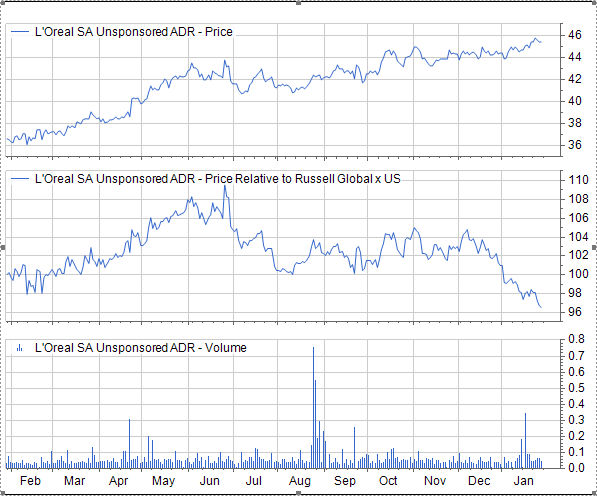
Past Year Performance: Over the past year L’Oreal has achieved a price high of $45.71, a low of $36.14 and is currently at $45.51. Their growth in new markets was 8.1%, 2.5% in Western Europe and 2.3% in North America. Management continued to improve their margins while increasing research and development. While last year L’Oreal’s debt to equity ratio was concerning the repurchasing throughout 2017 has continued to strengthen their shareholder return.


My Takeaway: Management has been proactive on the trends of the market and they have successfully integrated their acquisitions. L’Oreal currently dominates the industry with a 12.6% market share in cosmetics. This dominance is due to the combination of an increased presence in the e-commerce market and the utilization of more natural and organic ingredients. L’Oreals transition from traditional marketing and sales channels has given them a great advantage over their competition. While the slowing of growth trend in the market is concerning, L’Oreal has shown they are willing to adapt and continue to grow. L’Oreal in the last four years has grown about 57% and is at the forefront of product development. They have very respectable financials and will continue to dominate the cosmetic industry for years to come. This is a HOLD recommendation.